Tuesday, March 27, 2007

Swiss Chard and Better-Late-Than-Never Scarves: A Kitchen-Sink Post

Hi, folks!

Spring time has me all a flutter over here in Northeastern parts. I've been jealously devouring all the posts from the Northwest bloggers, what with th
eir pictures of flowering trees and their getting-gardens-ready-for-planting. Oh, and the fact that they already have spring produce at their farmers markets. But then just today, I saw the first crocuses blooming around a still-nekkid tree over on Tremont Street. Oh, did my heart twinge with joy. I. Can't. Wait.

Some of you may remember my garden from last year. It w
as a bit of a disappointment for my first back-porch garden, so I thought I'd scale back a bit this year and start with a fresh perspective on the whole she-bang. First off, I'm scrapping the veggies for the time being. It's just not feasible in my little container garden and I feel really happy about buying produce from my farmer's market, so we'll leave that until I have an actual garden. Or a job that allows me to devote more time to caring for veggies.

I bought a whole mess of flower seeds that I'm pla
nning on scattering willy-nilly in several of my containers. We'll see what pops up with those. Theoretically, I should have already started seedlings or at least (I think) scattered the seeds last fall, but...well...meh? I'll be happy with whatever little flowers decide to poke their faces up at me.

And then (here's my Smartest Move Yet!), I ordered actual seedlings of several diffe
rent culinary herbs that will magically, miraculously, oh-so-perfectly arrive at my doorstep just when they should be planted in the garden. So wonderful. So perfect. And even so affordable! I think I'm getting six different herbs for about $17. I can't WAIT for fresh herbs again. The more I've gotten into cooking this past fall, the more I've been learning and discovering new ways to use herbs. I didn't feel like I really took advantage of the herbs I grew last summer because I honestly didn't know how to use them--unless a recipe called for a specific herb, I didn't think to try adding anything different. This summer? A whole new kinda Emma, just you wait!

Ok, a few updates:1) I have finally finished Stephen's scarf. I custom knit some Urban Mitts (a.k.a. the Aid-and-Abet Smoker's Gloves) for Stephen last fall (link HERE) and apparently at some point agreed to throw in a hat and scarf with the leftover yarn. I don't actually recall this conversation, but Stephen was quite insistent that it did, indeed, occur. I have my doubts, but nonetheless, I did have leftover yarn and so...why not?! Well, other projects struck my fancy and with this and that, I didn't get around to finishing this scarf until a few weeks ago, just as the weather started to turn. I call it "Stephen's About-Time Scarf" and used the My So-Called Scarf pattern from Sheep in the City (link HERE). I love love love with a cherry on top and a few extra dollops of creme fraiche this pattern. It was fun to knit--never boring--and I felt very accomplished to have mastered the stitch (it's not actually that hard, but it looks that hard--the best of both worlds). The resulting fabric is kind of squishy or spongy, kind of like the waffle-weave on thermal shirts and absolutely perfect for a cozy scarf. I also have dreams of a cardigan in this stitch, but I'm afraid that will have to remain in Knitted Dream Land for a few more months. I knit this scarf length-wise because I was worried about running out of yarn (which I did. I even used all my little tail-scraps to finish binding off the last row! But look how symmetrical I got the stripes to be!). Oh, and a hat? Did I agree to a hat? I don't remember a hat...*Note to anyone out there thinking of commissioning some great knit good from me--I'm more than happy to do it, but don't expect anything in a timely manner. True art takes time, don't ya know. But wine and a steady supply of Top Chef DVDs will also help get the job done. Just sayin'.

2) The next book in the Keys To The Kingdom series by Garth Nix is out and in stores! It's called Lady Friday and picks up the story of our intrepid young hero, Arthur, just as he has taken the fourth key. Unlike the other books in the series which wrapped up the individual book with minimal cliffhangers, the recent book (Sir Thursday) ended practically mid-sentence. I believe I may have gasped when I turned the page and saw that the book just...just...ended! So it is with much delight that I anticipate reading this fifth book. Stay tuned, fellow lovers of young adult fantasy!

3)
And last but not least, I leave you with the recipe and mouth watering pictures for my new favorite comfort food: Polenta with Parmesan and Olive Oil Fried Eggs and Garlicky Swiss Chard. Mmm, mmm...good. If only I had a few black truffles to shave on top, this dish would take no prisoners. All the flavors combine so perfectly--especially the creamy polenta, the runny yoke, and the crispy edges. I'm a huge fan of wilted greens, their bitter flavor and slight chew make a great contrast to the egg and polenta. I would like to point out that this simple dish combines every flavor profile: sweet, salty, bitter, sour, and umami.

This dish comes courtesy of the New York Times and their article "A Morning Meal Begs to Stay Up Late," published 2/7/07. (Click HERE for the article--though it may be content protected) I have made a few adaptations from the original recipe.

Polenta with Parmesan and Olive Oil Fried Eggs

Yield--four servings

*Note: This recipe for polenta makes the best polenta I've ever made--very creamy and smooth. It makes several cups, so I usually pour the leftovers into a bread loaf pan, cover with saran wrap, and let set. You can then cut off blocks of polenta as needed from the 'loaf.'

4 1/2 cups broth or water (I use half chicken broth and half water--all chicken broth makes the polenta taste a bit 'tinned,' in my opinion)
1 1/2 cups polenta (not quick-cooking), course corn meal, or corn grits. (I use Goya brand corn meal)
3/4 teaspoon salt
1 1-oz chunk of Parmesan cheese

2 Tablespoons olive oil
8 large eggs (or 1-2 eggs per person)
course sea salt for garnish

1. In a large pot, bring broth/water to a simmer (not boil). Gently shake in the corn meal a bit at a time and add salt. Simmer, stirring as frequently as your arm muscles can stand, until it thickens to taste--between 10 and 20 minutes. Cover pot to keep warm.

*If making the chard as well, start the chard wilting now.

2. Using a vegetable peeler, shave the cheese into slivers. Alternately, grate it on the largest hole of a box grater.

3. In a large skillet, heat 1 tablespoon of olive oil until very hot. Fry 4 eggs at a time until edges are crispy and the yokes are still runny. Repeat with remaining oil and eggs.

4. Pile polenta into 4 bowls and top with first the cheese and then the fried eggs. Garnish with sea salt.

Garlicky Swiss Chard
(if serving with polenta and fried eggs, cut the chard before starting any cooking and then start wilting the chard after the polenta has finished cooking.)

2 bunches of Swiss chard, stems removed (You could really use any leafy green, here. I think I might have actually used collard greens by mistake, and it was still delish.)
1 tablespoon olive oil
2 garlic cloves, minced
Large pinch of crushed red pepp
er flakes
Juice from one half squeeze lemon
Salt to taste.

1. Stack chard leaves on top of one another (you can make several piles), and slice them into 1/4-inch strips

2. Heat oil in a very large skilled. Add garlic and red pepper flakes, and saute for about 30 seconds, until the garlic is fragrant. Stir in the chard, turning to coat with oil. Cover pan and let cook for about 2 minutes until chard is wilted. Uncover, stir, and cook for 2 minutes longer.

Serve alongside the polenta with fried egg, and squeeze a bit of lemon juice over the top just before serving.

Weight Watchers Points: One egg, a half cup of polenta, a few shavings of Parmesan, and as much chard as you want will equal about 5 points.
Saturday, March 17, 2007

Cooking: Snow Days and Soda Bread

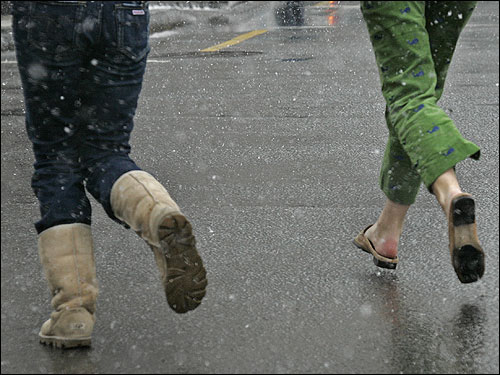
Since I didn't manage to extract myself from the cozy, multi-blanketed nest of my bed until well after the snow had passed from pristine prettiness into half-melty sludge, I give you this picture from Boston.com taken yesterday afternoon. Besides being yet another beautiful example of the fashion faux pas and arch-collapsing train wreck that is the Ugg boot (oh, why do I torture myself?), this photo so perfectly captures how unwilling we Bostonians were to deal with snow after a week of 55-degree weather--much less the blizzardy ice storm with sideways blowing snow pellets that we ended up getting. In my my three years in Boston, I can't help but notice that Bostonians have quite a time-honored "willing suspension of disbelief" going on here. To name a very few, we are willing to believe:

Fuggedaboudit.

A good pummeling of snow seems to bring out the best and the worst in people. This morning, it's bringing out the best. Determined to make Irish soda bread
for a St. Patty's Day party later today and lacking the proper ingredients, I cinched on my snow pants, laced up my snow boots, and prepared for the worst. But then...the worst never came! When I realized that my local CVC doesn't carry buttermilk* and realized that a bus trip to the nearest Stop&Shop would be in order, I was sure my good mood was doomed. But then, miracle of miracles, a bus appeared on the horizon mere moments after I arrived at the bust stop. In attempting to board the bus, I managed to drop my shopping list, wallet, and T-pass at the same time, thus delaying the boarding of fellow passengers and departing of the bus. I apologized profusely to the bus driver, but instead of rolling her eyes or gazing disdainfully past my left ear--a normal and accepted reaction to passenger ineptitude--she actually said (get THIS!), "No problem. Welcome aboard." No problem? Welcome aboard?! Did anyone else hear that? But no, my fellow passengers were gazing placidly out the windows, not even minding that I was (continuing) to delay the bus by standing in the doorway, immobile with disbelief.

At the grocery store a group of local firefighters all dolled up in their boots and suspenders were shopping for a St. Patrick's Day dinner toge
ther--a very meaty St. Patrick's day dinner, as became increasingly obvious as I followed them around the grocery store. (Side note: I wasn't actually "following" the firefighters in the stalking sense; our shopping routes just happened to coincide is all. Though they were pretty adorable.) There was one Papa Bear Firefighter with the cart and all the other firefighters kind of orbited around him, bringing him cuts of meat for approval, adding condiments to the cart, dropping off sodas. I was especially touched when one swarthy-looking fellow added two beautiful purple rutabagas to the mix. I loves me a veggie-eatin' firefighter! And the whole time, the group was joking with each other, teasing the Stop&Shop employees (who they seemed to know quite well), and chatting with fellow customers. They even posed for a few pictures. It was all very heartwarming.

I found all my purchases, trotted back to the bus stop, and again waited mere moments for another bus to show up. The doors slid open and who should I see but my new favorite bus driver! "Good morning," she said as I climbed up (managing not to drop anything this time). "Good morning!" I chirped in reply. When I got to my stop, I actually walked all the way to the front of the bus just so that I could say, "Thank you!" as I got off. "You're welcome," she said gravely as the doors wheezed shut behind me.

And in one last feat of snowy-day good cheer, I passed the mailman on the short walk from the bus stop to my house. I always feel bad for mail carriers on the particularly gross weather days--rain or shine, they're always out there, but they always seem quite w
illing and happy to be doing what they're doing. In any case, peering at me from beneath his fur-lined, US Postal Blue hat**, my mailman said, "Hello! How are you?" "Quite well, thank you! And you?" I replied. "Oh, I'm great!" he said, and slushed past me, whistling a little tune.
-----
*By the by, I'm not quite sure why I thought CVS would carry b
uttermilk, but I rilly wanted to believe it would--ahh...there's that suspension of disbelief! Hey, I'm a real Bostonian!

**
Every time I see a mail carrier now, I totally think of the Project Runway episode where they have to redesign the US Postal Service uniform. I saw a mail woman a few days ago wearing a particularly fashionable uniform (I thought) and I almost stopped and asked her about it. That was on a day when snow was making Bostonians grumpy, though, so I decided not to.
-----

Irish Soda Bread

I've shied away from soda bread for a long time. My memories of it are of dense, dry, crumbly bricks with little taste or satisfaction, which are left in the bread basket long after the hunks of airy baguette and elegant slices of sourdough have been claimed. In the build up to St. Patty's day, a number of recipes for soda bread--both sweet and savory--came my way and I decided to give it a whirl in my own kitchen.

I decided on a sweet bread with raisins and nutmeg and held my breath as the rocky, unappetizing balls of dough baked into golden loaves twinkling with granulated sugar. In both taste and consistency, this bread reminds me of scones. The crust is both crunchy and crumbly, with a satisfying chew. The interior was cakey and moist, rich with a light sweetness and chewy little nuggets of raisin. This cake was the perfect finish to the corned beef stew cooked by our St. Patrick's Day hostess, and was wonderful on its own, smeared with butter, or paired with the traditional sharp cheddar cheese.

In my research for this recipe, I found that soda bread is traditionally baked in a cast-iron skillet so that the top and bottom get crunchy and brown evenly while the middle stays cakey. I don't have a cast iron skillet (yet--I know, I know, it's sin that I don't have one yet), but I thought I could replicate the effect in my dutch oven. This recipe makes two loaves, so I baked one in the dutch oven and one on a regular baking sheet. (In the picture of the two loaves above, the one on the left was done in the dutch oven.)

Both loaves rose about the same amount, but the dutch oven loaf had a rounder shape and more even surface; where the loaf backed on the sheet was craggier and less uniform in shape. Additionally, the loaf baked in the dutch oven did indeed have a more even brown color and crunchier crust while the inside was noticeably more moist. The verdict? If you have a dutch oven or cast-iron skillet, I definitely recommend baking the loaf in it--just add about fifteen minutes to the baking time and remove the lid in the last five minutes. However, if you don't have a dutch oven, never fear--your bread will disappear just as fast.

Sweet Irish Soda Bread

Makes 2 loaves

4 cups flour
4 teaspoons baking powder
1 teaspoon baking soda
3/4 teaspoon salt
6 Tablespoons granulated sugar
1 teaspoon nutmeg (1 1/4 tsp if using freshly ground)
4 Tablespoons cold unsalted butter, cut into chunks
1 1/2 cups thick buttermilk
2 egg yolks
2 teaspoons vanilla
1 1/2 cups raisins (purple or golden)

Set oven to 375-degrees. If using a dutch oven or skillet, put it into the oven to warm as the oven heats.

In a large bowl, combine flour, baking powder, baking soda, salt, sugar, and nutmeg. Add the butter and use the tips of your fingers or a pastry cutter to work the butter into the flour until it reduces to pea-sized bits. Add the raisins and toss to coat with flour (this helps the raisins stay suspended in the batter).

In another bowl, whisk together the buttermilk, th egg yolks, and the vanilla. Create a well in the center of the flour mixture and pour in the liquids. Use a wooden spoon to stir the mixture until all the ingredients are combined and the dough easily comes together into a ball. It will be very moist and shaggy.

Divide the dough in half and form each half into a ball. Use a sharp paring knife to slash a cross into the top of each loaf about 1/2 inch deep, a traditional feature of soda bread that also allows the dough to expand while baking without cracking the surface. Sprinkle each loaf with a few pinches of granulated sugar.

If using a dutch oven or skillet, drop the dough (cross-side up) into the bowl and cover. If using a baking sheet, cover a baking sheet with parchment paper and set the dough in the middle. Bake loaves for 40 minutes or so until the surface is evenly golden, the center is set, and a cake tester (or toothpick) inserted into the center comes out clean. (Loaves baked in a dutch oven may need another 15 minutes to bake. Leave the oven uncovered for the last 5-10 minutes of baking.)

Allow the loaves to rest at least 1/2 hour before serving.

Weight Watcher's Points: Each loaf is about 34.5 points total. If you slice it into 12 wedges, each wedge is about 3 points a piece.

Friday, March 09, 2007

A Craft Room of One's Own...

For as long as I can remember, I've dreamed of having a room of my own. Even when I was still living with my parents and technically had my own room, I still nurtured a fantasy dream room in my heart. Back then, the primary features of My Room were a loft with a big cushiony bed and various hidden doors, secret compartments, tunnels leading to other various sub-rooms, and all sorts of very mysterious and intricate designs. Since then, my tastes have evolved and become (somewhat) more practical, though the loft idea does still drift in and out of the picture depending on my mood.

These days, the room I lust after is part craft room, part lounge, part sanctuary. A room that's neither too big or small, but it's just the right size to fit all my things into and close the door. Somewhere I can leave projects out and make a mess without feeling the need to clean it up right away and organize everything just the way I want to. Along one wall would be big square-shaped shelves stacked nearly to the ceiling. These shelves would hold bins of yarn (organized by color, fiber, and texture, of course), my favorite books, and all my various Special Trinkets, of which I have collected many. My desk would be in front of the windows, which would be curtained in beautiful fabric sheer enough to let in sunlight, but opaque enough to provide privacy. It would be a big, long desk with my laptop at one end and the rest completely clear for whatever project I happen to be working on.

Against another wall would be a comfy love-seat couch with fold-out bed. Big stuffed pillows. A side table. Lots and lots of warm, glowy lamps because I'm very particular about my lighting and loathe overhead lights. Bright, patterned sheets of colored paper or simple tapestries of hemmed fabric would decorate the wall behind the couch. Everywhere the colors would be cinnamony-orange, burgundy, and steel blue. Accents of moss green here and there at the edges. All the furniture would be mostly blonde wood with some stainless steel for that bit of edge. A handknit blanket over the back of the sofa, and a cozy, broken-in sweater over the back of the chair. A warm, squishy rug on the floor.
The light is always autumn and somehow it's always warm enough for bare feet, but cool enough to settle down with a sweater or scarf around my shoulders.

Oh, it all sounds almost too cozy and lovely to be true. I dream of this room and dream of sitting at the desk, lying on the carpet, napping on the sofa, running my finger along the spines of the books on the shelf. It's funny that I've never really thought in terms of a whole house or an apartment--it's always just been this one room. But a house would be too large for little me; a room fits me just fine.

What's your fantasy hide-away?!

Thursday, March 01, 2007

Books: The Children of Men by P.D. James

The Children of Men
by P.D. James


Quickie Synopsis: Set in the not-too-distant future of 2021, Children of Men tells of a time when humans have become sterile, science has failed to find a cause or a cure, and no children have been born for twenty-five years. The Warden of England holds the country from chaos by promising security, comfort, and pleasure through a thinly-veiled dictatorship as civilization fades into old age. Theodore Faron, the Warden's cousin, is one of the apathetic masses until he is approached by a group of rebels eager to change the system. Initially reluctant to help, Theo is drawn further and further into their plans and finds a passion awaking in him that he thought he'd lost long ago.

***

I have a border-line obsession with stories of the apocalypse. Give me a good end-of-the-world novel (or movie or art show or podcast or...you get the idea) and I'll cancel all appointments, hole myself in my apartment, and refuse food and drink until I've finished devouring it. Good apocalyptic and post-apocalyptic books are hard to find--both because there aren't that many that have been written and also because they often get shuffled into other, misnomer categories and are hard to find. By my definition, apocalyptic books are NOT stories of utopian or dystopian societies. They are not science fiction (by my definition, anyway). They do not involve any society other than humankind or take place on any world other than Earth. The events being described do not happen more than fifty years in the future. The best stories of apocalypse deal specifically with the end or near-end of the human race and could happen at any time to any society--The Stand by Stephen King, The Road by Cormac McCarthy, and the movie 28 Days Later are primo examples of this.

At the root of my obsession is an insatiable curiosity for how humans behave when all the trappings of 'normal' society are stripped away. We humans cling so tightly to arbitrary ways of defining ourselves and our place in society--ideas of ourselves as doctors and housewives and baristas and public-transit-commuters and radical thinkers and protesters and parents and nerds and food critics on and on and on. What happens when all these labels become meaningless? What is there to protest when there is no more government? Why collect money when there is nothing left to buy or no one left to sell it to you? How do you find food when you've only bought frozen dinners from the grocery store your entire life? What happens if you have any kind if disability and were dependent on technology to function? How will you spend your days when life is about survival instead of toeing the line? How do you define yourself when you are no longer being marketed to or pigeon-holed or compared against? I find these questions fascinating. I am obsessed with knowing all the possible permutations of the human spirit within this kind of vacuum.

And it was with this level of exuberance and fascination that I approached Children of Men. I hadn't heard of this book before previews for the movie started airing and everyone at the Noodle Factory was gibbering about it. A friend of the Engineer's who works in movies saw a sneak preview and declared that this would become a seminal movie for how humans think about the future, and that we would look back on it decades from now and see how the ideas from this movie came to pass. And thus my excitement grew.

As is my habit, I wanted to read the book before seeing the movie, and was delighted when I discovered that the original book had been written by P.D. James, an award-wining British mystery novelist. She is most well-known for her Adam Dalgliesh series, which was turned into a well-respected BBC mini-series. Her mysteries tend to be highly-detailed and fast-paced, and James imbues her characters with genuine ethos as she propels them through the twists and turns of her novels. When the killer is revealed in the grand finale, it's often done in the way you'd least expect with a twist that gives readers cause for genuine reflection.

I wasn't surprised that I'd never heard of Children of Men. It was written in 1992 (which was a whole different century, after all), doesn't fit in with her mystery-novel repertoire or appeal to her fan-base, and also....well...it just isn't any good. It was really, utterly, tragically disappointing. How some crazy script-writer or director came across it and decided to make it into a movie, I'll never know. Actually, they were probably going through all of P.D. Jame's novels and wondered why no one had made it into a movie yet. I'll tell you why--because it would take a script writer or director of singular creative genius to find the diamond in the rough in this book. I've heard such stellar things about the movie from people who's taste I trust that I can't WAIT to see the adaptation.

The first half of the book focuses entirely on Theodore Faron, our main character and apocalyptic hero. He has just turned fifty and is ruminating about his life and the deteriorating state of humankind. As a historian, he feels himself somewhat removed from the events going on around him. His voice as the narrator is clinical and detached, and his observations are unemotional and objective. He is approached by a representative of a small group of rebels and asked to represent their concerns to the dictatorial Warden of England, who happens to be Theodore's cousin. Theodore has little interest in what he considers to be their juvenile grievances and initially dismisses them in disdain. He is only convinced to talk to his cousin after he witnesses a government-organized and theoretically voluntary mass suicide for elderly men and women. Theodore's attempt to communicate with the Warden is clumsy, ill-prepared, and ultimately ineffective. Theodore's momentary enthusiasm for action subsides back into depression.

In the second half of the book, Theodore is once again approached by the rebel group, now calling themselves the Five Fishes, and this time he is asked to provide protection. One of the members, Julian, has become miraculously pregnant and the group needs Theodore's help because he is ostensibly the only man in Britain who can keep Julian from falling under the control of the Warden (a thin premise). Lucky for young Julian, Theodore has fallen in love with her and would do anything to protect her, even overcome his own apathy. What ensues is an unimaginative race through the English country side as the group tries to evade detection, meets with bands of feral humans, scavenges for supplies, and is ultimately hunted down. The climactic scene is so goofy that I don't even mind spoiling it for you--Julian's baby is born, and then Theodore kills the Warden, assumes his place, and wins Dame Julian's affection. Nice. And. Tidy. Barf.

The main characters are particularly disappointing. Theodore has heroic potential, but his transformation from cold observer to humanitarian hero is poorly conceived and unbelievable. Julian and the other Five Fishes are all caricatures of themselves. Each plays out a specific symbolic personality whose literary history can be easily traced through the great (and far greater) works of literature that precede this one and whose permutations have been long exhausted. The Warden is probably the most intriguing and well-written character in the book. He is multi-faceted and has a depth of spirit with which readers can truly empathize. Unfortunately, inconsistencies in his character keep him from being truly believable and trustworthy. (Why why WHY would P.D. James think that at this stage of the apocalypse, the Warden would still be testing only the fertility of those humans he deemed "healthy" and not ALL humans regardless of their mental or physical impairments or their criminal record? A character as smart and survival-oriented as the Warden would recognize that the end of humanity is not the time to practice eugenics. It baffles me.)

The only reason for reading this book at all is for the novelty of it's apocalyptic vision. The idea that no more children are being born and that the human race will just slowly fade into obscurity is a unique idea worth considering. Every other apocalyptic book I've read assumes that the end will happen relatively quickly and without a lot of advanced warning: nuclear annihilation, a super-plague that sweeps around the world and leaves bodies piled on street corners, uncontrollable tidal waves or earthquakes or meteors. One day everything is fine; next day, no more humans. With an apocalyptic event like this, humans can only react and survive as best they can. In a scenario like the one in Children of Men, the apocalypse evolves gradually one day at a time, always lurking on the horizon. Humans have plenty of time to get familiar with the inevitability of their situation. They have already moved beyond the initial stages of panic, hope, and despair, and have settled into resignation. They have time to plan, prepare, and decide how they are going to face the end. It's a different kind of survival and a different aspect of the human soul.

The first quarter of the book, which consists almost entirely of excerpts from Theodore's journal and includes his observations of events going on around him, gives a nice snapshot of what human society could be like in this kind of apocalyptic scenario. Theodore describes the feeling of despair when the last generation of humans reached their mid-twenties without becoming pregnant, the special treatment those last children received, the growing popularity of mass suicides, the preparations for consolidating the last humans into urban centers, how the remnants of the government will ensure that there will be enough resources to see the youngest generation into old age, and all the other signs of a society coming to terms with it's own death. In this sense, society exhibits all the characteristics of any individual come to the end of their life: crankiness, despondency, dementia, weariness, relief, rebellion, fragility, resignation, and acceptance--all wrapped into one package.

One of the key characteristics of all apocalyptic books I've read so far is a final note of hope. The good guys win. The child is born. The last survivors find one another. Life begins anew. Sometimes this is done very well (The Stand by Stephen King and the movie 28 Days Later). Sometimes it feels forced (The Road by Cormac McCarthy). And in the case of Children of Men, it's downright wrong. However it's handled, so far there are very few books where the author was able to bring him or herself to actually end the book with the idea that the human race comes to an end.* Especially in the case of The Road, it is as if the author builds up and up and up to the conclusion that humans fail and ultimately die out, but at the last minute just can't follow through and HAS to end on an up-note. This phenomenon in and of itself says something interesting about human nature--maybe it's a fundamental instinct of self-preservation that prevents authors from 'going all the way,' similar to how in dreams, you will always wake up before you see yourself die. It's as if denying hope is denying life itself.

And so I await with feverish anticipation the release of Children of Men on DVD.** Even if it only lives up to half the reviews I've heard, it's bound to be more entertaining than the book and promises a few more glimpses into the depths of human spirit.

***

*Now that I think about it, the only book I've encountered where all humans do actually die is in The Brief History of the Dead by Kevin Brockmeier. But even in that book, it's implied that the human SPIRIT lives on, even if not corporeally.

**Yes, I'm a notorious tightwad, and by the time I'm done debating whether or not it's worth coughing up $10 to see a movie, it's usually left the theaters.

***

Final Recommendation: Skip the book; see the movie. If you insist on reading the book, stop after Theo goes to the Quietus and meets the Warden.

Good Read for When You're: Doing research for a book on apocalyptic visions.

Good Choice For: Someone you know is doing research on apocalyptic visions. Or is having apocalyptic visions.

If you're interested in having some apocalyptic visions of your own, I highly recommend:
The Road by Cormac McCarthy
The Stand by Stephen King
28 Days Later

If you'd like to read some good books by P.D. James, try:

Death of an Expert Witness
Devices & Desires
Original Sin

Sunday, February 25, 2007

Yarn: Daisy Dukes--Oh, it is BROUGHT!

Well, y'all, the much-anticipated and widely discussed Boston Heat Wave of '07 (Forty degree highs! Meteorologists in a tizzy!) met with an abrupt and untimely finale yesterday when we awoke to a crispy layer of new snow over the still-unmelted varnish of ice on the sidewalks. But it left me with hope. Hope for a New Spring. I have historically been a big proponent of winter and all that is wonderful in the season, but for some reason this year I can't wait for spring. I can't wait for the farmer's market and to plant my seeds. I can't wait to wear all my impractical strappy summer shoes and my favorite skirts. I can't wait to go for runs outside without constantly being on the lookout for patches of ice. Yes, I know we've had a mild winter this year and got off easy with only one big storm (so far), but somehow, that has made me even more antsy. I'm ready to let this winter fade into memory and embrace the sun again.

And with the warm weather on the horizon, it is once again time to begin watching for that elusive and migratory beast: Campusious Hottius (a.k.a. Campus Hotties). Yes, the Engineer will soon be deluged with young hotties walking around campus pursuing such valid trades as sun bathing and too-short-skirt-wearing.
This is what I'm up against:

I am not at all intimidated by these hotties (*cough,cough*...ahem), but I do find them infinitely fascinating. Since he spends most of his days on campus, the Engineer is constantly coming home with stories of Young Hottie sightings, stories that are usually accompanied by much shaking of the head and exclamations of, "NO! You're kidding!" on my part.

Ok, I'm not exactly intimidated by them, and to any young hottie wishing to snag the Engineer, I say "You best bring it!" But still...they do know how to make a gal feel, well, decidedly uncool. It's like these young'uns are constantly saying, "Yeah, I know ugg boots are UGGly and these shorts are too tight and this skirt shows my undies, but I'm so hip that I don't care. What are you, like, twenty-five? You're too old to understand." The aura of coolness oozes from their pores and you feel it in the specific passion of their disregard.

So this year I've decided to take a pro-active approach. It's time to make uncool cool again. It's time to Bring Back the Fashion. Yes, it's time for dai
sy dukes. And not just any daisy dukes, but knitted daisy dukes:

Daisy dukes, y'all! I missed this fashion train wreck back when it was actually "popular," but I feel the time is ripe for a come-back: Knittin' Style! We're talking soft blue denim yarn. We're talking belt loops made of i-cord. Fringe of elegantly unraveled bits of yarn. Oh, how to knit those interior pockets hanging so deliciously below the hem-line? My fingers do tingleth with joy...

I think I will base my pattern on the Sweetheart Shorts from KnitPicks (click HERE), though I'll have to modify it a bit to work in the pockets. Plus I think the waist line will need to be several inches shorter--we need to make sure those belly buttons get their time to shine.

And I know you're all sitting there wondering if I'll actually model my dukes in public once finished. Alls I can say is, all you
Campusious Hottius out there? You best bring it!

Wednesday, February 21, 2007

Wine: 2003 Mountain River Pinotage/Shiraz

2003 Mountain River Pinotage/Shiraz from South Africa ($7.99 at Trader Joe's)

I first had this wine back at our Cross-Atlantic Holiday Festivus and liked it so much that I wanted to try it again when I had a chance to really pay attention to what I was drinking. At the time of the party, the wine steward at Trader Joe's had recommended it because he felt it would pair well with the highly-spiced Portuguese and Brazilian dishes we were serving. In my vague recollections of the evening, I remember being surprised at the strength of the wine--it wasn't a bad pairing with my food, just unexpected. This time around, I'm trying the wine by itself, unpaired with any food.

In the glass: Dark and completely opaque. Ruby-lit highlights when you hold the glass up to the light

Scent: This wine smells strongly of fermentation and slightly musty--like walking through forest with a thick ground covering right before it rains. There is a definite perfume of dark berries (blackberry, cherry, and maybe currant?). The scent is powerful and forceful--even with my glass sitting next to my computer about a foot away from my nose, I can still catch a whiff of berry and pleasant mold.

Taste: Heavy and rich, almost "thick" tasting. More of that mustiness in the taste as well--I think immediately of rich cheeses like blue cheese, gorgonzola, and roquefort.
It's not an unpleasant taste, but not always one I'd want in a sipping wine. The individual berry flavors aren't as prevalent in the taste as in the smell, but the effect is still fruity. Very smooth, not a lot of tannins (that puckery flavor present in a lot of younger wines). The overall taste is quite bold. It really coats the entire tongue uniformally. There's no spiciness--it really "sits" on the tongue and lingers a long time after you swallow a mouthful.

Pairings and Culinary Uses: This would likely be a great wine to use in cooking--a nice tomato sauce, beef stew, glazes for steak and lamb. Might also be pleasant as mulled wine or sangria. I've also been reading a lot lately about making your own red wine vinegar, and it would be interesting to see this wine become vinegar and then to use it in a dressing for a salad with gorgonzola and walnuts.

I don't think I would often drink this on its own--it seems like a wine that's meant to be paired with food. However, it might be too heavy to go with the main course itself and would tend overshadow a meat-centered dish (like steak) rather than enhance it. If you want to pair it with dinner, go for highly spiced foods like Mexican or even Indian. I think this wine would be best drunk as an after-dinner wine. It would be fantastic with a cheese course or a dairy-based dessert like cheesecake, creme brulee, or custard where the flavors between the food and the wine would have a chance to play off each other and mingle.

Overall, I really like this wine. It's bold flavor is unexpected and incredibly balanced for an under-$10 bottle of wine! Because its flavor pairings aren't as versatile, it really inspires me to think of dishes it really would pair well with. It also makes me crave cheese, and cheese is always a good thing in my book.

Saturday, February 17, 2007

Craft: Yarn! All I really need is Yarn! Yarn! Yarn!

Ok, first and foremost, an update on the Engineer Sweater. It's so almost done, I can taste the finished-blocked-ness of it. I am about a third of the way done with the second sleeve--the final piece of this puzzle. I made the Engineer stand still for me while I pinned the pieces onto him and checked that it was all going to come together ok. He was antsy to get back to his analyses of drag coefficients and centers of gravity, but oh no, sir. I made him stand for a full thirty seconds while a gazed adoringly at how perfectly everything fit and made little cooing sounds while stroking that symmetrical sleeve.

I am impressed, slightly amazed
, and very relieved that it looks like it will fit. In what we'll just call "A Knitter's First-Sweater Mistake," I didn't think to double-check that my gauge was accurate until, oh, I'd knit the entire front piece and half the back. When I did, I realized that my gauge had mysteriously gone from perfect (at the time I knit my swatch) to much much less perfect (at the time when I gazed in horror at my ruler, counting and re-counting my stitches-per-inch). Just imagine--your perfect pattern-matching gauge is 10 stitches per inch, but your reality-sucks gauge is actually closer to 13 stitches per inch. It might not seem like a lot, but those little 3 extra stitches add up and...well, your sweater is going to be too small. It's a terrible, terrible thing to realize, my friends. Lucky for me, the Engineer tends toward the scrawny side and the smallest size in this pattern would probably have ended up being a bit large on him anyway. I did some measurements and enlisted some nearly-forgotten math skills and decided it would *probably* be ok. What's a gal to do but knit onwards?

Now, my energy for this project has been flagging and
I have to admit that tried (unsuccessfully) to persuade the Engineer that one-sleeved sweaters are sure to be all the rage this spring season. He wasn't buying it and is demanding the second sleeve. Fine. This sweater will be finished before the swan boats return to the duck pond at Boston Garden! You're all my witnesses.

Side projects are a necessary and healthy part of any long term project. I give you, the Nose Warmer. I'm knitting two of these handsome warmers for a friend of mine and his son. They knit up quickly and are a good refresher course on short-row shaping--the 'nose' is very similar to turning the heel on a sock. I just need to give these noses some whiskers and attach the head-ties, and they're ready to go warm some noses. For interested parties, the pattern is over at Knitty--click HERE.

A few weeks ago, I placed a big order for yarn from KnitPicks so I could price out the cost for making hats and scarves for Angelina over at Dustpan Ally. I am so excited to have discovered KnitPicks. I've wanted to sell my handknits ever since my family started politely insisting they had enough hats, scarves, gloves, uteruses, penguins, and other knit items to last them quite some time. (Luckily, I've made new friends since who are more than happy to volunteer for handknits. Whew!) But the biggest obstacle to selling handknits is that it's rilly not cost-effective. Yarn is expensive! To recoup both the cost of the yarn and a bit more for my labor, I'd be needing to sell, say, a basic hat for at least $30 to the retailer, and the retailer would then need to mark it up again to make their money. So we're looking at a $50 or $60 handknit ski hat. Loony bins. Who would buy that?

Enter Knitpicks. Their yarn is affordable, very good quality, and available in a lot of different colors, fibers, and weights. It's pretty uniform, so if you're looking for the subtle beauty of hand-dyed or the unique texture of hand-spun, you're not going to find it here. But the yarn is dependable and good. My hope is that I can have a good base of these low-cost goods and eventually have clientele who would want and be able to afford handknits with more luxury yarns. I also hope that if all goes well with selling hats and scarves at Dustpan Ally, craft fairs, and the like, I can also start knitting larger, uniquely designed patterns like sweaters and bags.

For this initial, reality-based trial, I ordered a bunch of skeins of Wool of the Andes--a 100% Peruvian wool. For kicks, I also ordered a few skeins of Andean Silk--a blend of alpaca, silk, and merino wool. It was a bit more expensive, but I was worried that the Wool of the Andes might be too scratchy when knit and wanted to test out a different blend. (Update: I think Wool of the Andes will work just fine. A bit rough, but not at all "grandma sweater" scratchy. No offense, grandmothers out there. But still, you know what I mean.) I chose several colors that I will love to knit with (it's important to love what you're knitting) and that also will blend well together if I want to do any patterns: black, moss green, burgundy, dark blue, and cloud blue. I'm also going to play around with felted flowers, so I got a few skeins in pink, yellow, and orange.

With the scarves, I want to try different stitch patterns and play around with mixing stripes of different colors. One idea to make it a bit more interesting is to weave a strip or two of ribbon down the length of the scarf to add detail and texture. The hats could also have some felted embellishments sewn along the length. I'd like the stocking caps to resemble flapper hats. The felted flowers would be added as removable brooches over the ear, and I'd like to weave ribbon through the brims on a few of the hats by knitting a button-hole eyelets about one inch from the bottom of the hat. I have a couple other ideas for making these otherwise ordinary handknits unique and exciting, but I'm going to wait to talk about them until they're more solid in my head. I'm also planning on selling these under the name "My Three Loves" so am brainstorming ways to combine these loves of mine into a nice little package. Cuz otherwise it would just be kinda confusing and would be better to just sell them under my name. Any thoughts?

And last but not least, just when I thought my week couldn't get any better, I get this lovely package from Angelina.
Months ago, I started coveting her canned goods after a particularly scrumptious post she wrote on canning pears in vanilla syrup. I begged and pleaded and made a nuisance of myself, but Angelina eventually took pity on me and agreed to an exchange of goods: A jar of gorgeous pears in exchange for a comfy scarf done in the style of my laptop cozy. Angelina, the yarn is gorgeous. I stroked it for a full fifteen minutes and daydreamed about what a beautiful scarf it will make. You'll all be happy to know that I've perfected my bubble-making technique since the laptop cozy, and think I've got it down to a science. A full-on felting like I did for the cozy might make this yarn too stiff for a scarf, so I'm going to experiment with some light felting to try and get a fabric that is still supple and scarf-able. Oh, boy I can't wait!

Also can't wait to break into these pears. They have held a place of honor on my counter since their arrival and it makes my mouth water just looking at them.
I have considered and discarded half a dozen different recipes, still looking for just the right one. My most recent thought and the one I think I will ultimately do is a pear tartlet for the Engineer and I. We're celebrating a faux-Valentine's day dinner sometime in the near future (a.k.a. an excuse to go to the fancy grocery store and buy fancy foods!), and I think a pear tartlet would go quite nicely. Or I could just eat them straight from the jar with a spoon while standing at the counter in my pyjamas. That sounds good too.

By the way, if you haven't already discovered it, please do stop by Angelina's store, Dustpan Ally, and check out all the wonderful things she's got going on over there. The actual, real-life store is in McMinnville, Oregon, but if you don't happen to be in the neighborhood, you can also order off the web at http://www.dustpanalley.com/. Angelina is an amazing and creative woman, and I could buy everything in her store in a heartbeat.

Monday, February 12, 2007

Books: When Things Fall Apart

When Things Fall Apart: Heart Advice for Difficult Times
by Pema Chodron

When Things Fall Apart doesn't hold the answers with a capital "A" or preach dogma or threaten consequences if certain instructions aren't followed to the letter. It quietly and non-aggressively suggests an alternative way of thinking and living. This way of thinking has to do with being gentle with yourself and being gentle with whatever situation is throwing you off-balance--whether that situation is as mountainous as the death of a loved one or as quotidian as a rough commute to work. Pema Chodron draws from traditional Buddhist teachings to lay out some essential principles for living in our chaotic and changing world.

-----

My mother gave me a copy of this book years ago. She told me very matter-of-factly that it helped her through one of the worst depressions in her life, had changed the way she thought of herself and the way she lived, and that I should read it at some point. I have dutifully carted it around with me back and forth every semester in college, hauled it out to Portland, and shuffled it back across the country when I moved to Boston. It sat on my shelf beside the other "good for you" books (like What Color Is Your Parachute) that I knew I should probably read at some point. I picked it up a few times, but never really got much further than a few chapters. And
like the good little English major I once was, sentences here or there are dutifully underlined and marked with stars and little margin notes. But something always came up, or I got bored, or another more exciting book showed up at the library, and I never got around to finishing it. My mom never asked about it. I think she knew--as I understand now--that it's a book you have to be ready for. You have to be open to what Pema Chodron is saying and be willing to listen. I just needed to know it was there and that when the time was right, I would read what it had to say.

I found myself in this place this past winter. My work at the Noodle Factory was distinctly lacking in compassionate mindfulness and the Engineer was stressed out with finals and the weather was completely baffling (being both unseasonably warm and also dismally dark) and I was stressed out with money and with that age-old question "How the hell did I get here and where the hell do I think I'm going?" I decided to take When Things Fall Apart to work with me and read
one single chapter every morning before turning on my computer and while the entire office was still empty and silent. An empty office building is a different world and, I found, strangely conducive to meditation. And one chapter from this book is certainly not a bad way to start the day.

At root, the book is about being mindful--mindfulness being the act of being aware and honest and compassionate about what is going on around you and what is going on inside of you and what part you are playing in all of this. Chodron talks about disassociating ideas of "right" and "wrong" with the feelings, emotions, and reactions we are experiencing, and instead just accepting them as a part of the human experience and letting them go. We feel pain and fear when we cling too tightly to our idea of how things ought to be, and Chodron explains that the only way to deal with this pain is to experience it fully and to see it as an opportunity to learn something.

Up until I read this book, much of the Buddhist teachings I have encountered tend to feel a bit inaccessible and all too mysterious to an ordinary person. What's all this double-think of suffering leading to happiness and letting it all go in order to have it all? Why should I embrace hopelessness when what I really want is to feel love and happiness? Like a math equation, so much of Buddhist thinking seems to cancel itself out. This impression was probably a big factor in why it took me so long to get around to reading this book. I often think, "Oh, yeah, sure--if I were living in a monastery without worrying about how I'm going to pay rent and take care of my family and feed myself, I'm sure I could reach enlightenment too!" In the real world, things can seem a bit more complicated. Or at least insurmountable.

But one of the best aspects of this book is how grounded it stays in the real world. Perhaps because she came to Buddhism late in her life and after a difficult divorce, Chodron maintains a strong connection to the real world of bills, broken hearts, and public transit woes in her writing. This makes When Things Fall Apart accessible and understandable in a way
that no other other text has approached. And yet, don't think that Chodron's explanations are so basic and pedantic that you can just breeze through your daily lesson of compassion and mindfulness and open your Outlook inbox without another thought. There is still a lot of that Buddhist double-think that we Westerners find so hard to digest, enough to give your head a good spin. But as I forced myself to read slowly and think through what Chodron was saying, for the first time, I found it all starting to make a certain level of sense. Her basic messages are often relatively straightforward, but the meaning and layers beneath the message may require several re-readings before the subtleties are understood. Often I felt that I grasped the concept for just an instant before it slid away from me, but in a true model of Buddhist patience, I tried not to struggle to regain the understanding and instead imagined it sinking into a little storage container to be examined later.

Some of the accessibility of this book and her other writings also comes from the fact that Pema Chodron is American and a native English speaker. Unlike other Buddhist masters who are well-known in the United States (like Thich Nhat Hahn and
the Dalai Lama), Pema Chodron "speaks" the American culture and language. Since she also had to teach herself how to "think Buddhist," she understands the struggle this presents for the typical Westerner dealing with typical Western dilemmas. Pema Chodron is able to present these Buddhist teachings in a way that makes sense to her American audience and also retains the strength of the original wisdom. Her voice is personal and conversational, as if she's sitting on the couch next to you sharing a cup of tea. Her elegant writing is broken into bite-sized chapters that each focus on one simply-stated message, each able to be read in a sitting.

This is not a book that tries to convince you to become a Buddhist or that this is the only way you will ever be happy. Rather, When Things Fall Apart meets you where you are without judgment or marketing. It's a book to read slowly and carefully, while the office is empty and you have time to close your eyes, lean back in your chair, and take a few deep breaths before you start your day. And when you get to the final chapter and find you've only grasped a fragment of what you read, what's to do but start over at the beginning and read it all again.

Wednesday, February 07, 2007

Departing from the norm...

I debated for a long time before writing this post. I might yet chicken out and not actually post it. So far on my little blog, I've pretty deliberately stayed away from the really personal posts. I didn't want (and still don't want) this blog to turn into my online journal. Also, I have a hard time letting my guard down and telling people what's really going on with me. I always have to make jokes, be witty, make light of things, pretend that I'm stronger than I feel I am so that no one worries about me. I don't like feeling vulnerable. And I despise whiners. Especially whiners who don't realize they're whining or try to do anything to change what they're whining about. I don't want to be a whiner.

But here's the thing--I feel really...bummy. Bummy is both the perfect way to describe how I feel and also completely inadequate. I feel bummy in the way that I fully, objectively, rationally understand things aren't really so bad--things are pretty darn good, actually, if I were to tally everything up--but I've just felt a base level of...well, blue-ness. For a while now. Like a sine wave of ups and downs, and the average is just...bummy. Unexplainable. Or maybe very obviously explainable. But in either case, I feel like I might burst into tears at any random moment.

All right. I'm a list-making kind of gal, so do that tally. Here are all the fun, wonderful, inspiring, exciting, awesome things going on:

  • Things on the romantic front with the Engineer are wonderful. And in fact...
  • A few months ago, the Engineer and I decided to get hitched (glee!)
  • I'm loving my blog and am constantly inspired to do new posts.
  • It feels really really good and very right to be doing some form of creative writing again.
  • After a lot of personal work, patience, and perseverance, things at the Noodle Factory ( a.k.a. my job) finally feel like they're taking a turn for the better.
  • I have so many knitting projects I'm dying to do that I've been looking into getting a third arm. Though I guess I'd need a fourth arm too, since you need two arms in order to knit.
  • I recently talked to Angelina over at Dustpan Alley and we're going to try selling some of my hand-knits in her store.
  • After 6 months of not taking sleep medication and struggling with insomnia, I'm finally (and more-or-less consistently) getting a solid 7 hours of good sleep a night.
  • I'm going to an info session at the Cambridge School of Culinary Arts tonight to get some more details on their Professional Chef program, which I've 99% decided I'm going to start doing in the Fall.
  • Tomorrow, I'm meeting with a food writer who I contacted through a local writing program (the actual food writing class was cancelled, but that's on the list of bummy things), and am really excited to talk with her about the wily world of freelance food writing.
  • For the first time in my life, I can jog for 6 miles straight.
  • I'm really happy with my weight right now--something that's been a big challenge and source of stress ever since my teenage metabolism abandoned me.

Ok, I think those are the highlights. So here are some of the things stressing me out:

  • Feeling like I've got too many balls in the air--but feeling like the not-fun things are balls that I can't eliminate and the fun things I don't WANT to eliminate because they make the not-fun things bearable.
  • Even though things are better at the Noodle Factory, it's been a long haul and will continue to be a long haul and I'm tired.
  • I've been snarky at the Engineer lately and that makes me feel guilty even though when I apologize, he gives me a kiss on the forehead and tells me not to worry.
  • The food writing class that I was really looking forward to was cancelled.
  • While getting married and planning a wedding is fun, I feel like it's my responsibility to make sure everyone is happy with how everything is going (my parents, the Engineer's parents, the Engineer, our friends and family, all of whom may or may not get invited and may or may not be offended by that). I feel very anxious when I know someone out there isn't happy with me or the way I'm doing something. It makes me want to elope. Except I still want a pretty dress and a party. (See, there's the joking to cover up how stressed and anxious this really makes me.)
  • I feel like everyone looks to me to be the strong one and I'd like to take a break. (saying that made me start crying a little)
  • Money is really tight--not "Kraft Mac n' Cheese for dinner every night" tight, but tight all the same.
  • All my best shirts are getting pit stained. (again, the semi-joke)
  • Although that I'm happy with my weight and my health, I have been putting a lot of pressure on myself to maintain it because I'm so terrified of losing control of it again, to the point where I worry that it's become unhealthy.
  • I worry that I drink too much.
  • It's the winter and it's bitter cold and it's dark, and I think this might have a lot more to do with the base-level of blueness than I realize.
  • I have absolutely no idea what's going to happen in two years when the Engineer graduates. And that makes me both incredibly excited and overwhelmingly anxious.

So there you have it. I could really sum my feelings up (and all my longhand journal entries of late) by saying that I feel stuck. Or maybe trapped is a better way of saying it. Well, honestly? I feel like I am in the grips of something beyond my control. I feel that I've been working my whole life toward this--this moment, this time, this life--and now things are in motion beyond my control. And I'm terrified.

This gets complicated in my head, so bear with me. My idea of perfection is not what you might think. My definition of perfect is more of the Buddhist idea of being groundless--of knowing that as soon as you think you're on firm ground, the ground is removed from you. And also the idea of open expectation--if you don't try to control everything that happens to you, you are ready for anything, ready to take whatever opportunities arise, ready to listen to your heart and your spirit. And compassion for yourself. Understanding that mistakes and slip-ups are all a part of learning, and therefore mistakes and slip-ups are a part of being perfect by this definition. In fact, by my definition, making no mistakes and behaving socially perfectly is, well, imperfect.

So it's ironic, isn't it? Here I am, completely groundless. Hurtling through space. Being pulled along toward this future destination in which I am just a simple passenger trying to make sense of the scenery. Objectively terrific things happening all around me. All the seeds I have sown by being open and ready and listening to where my heart was leading me are now all coming to fruition. And I'm absolutely terrified. I feel completely unprepared. Maybe I never really expected it to work--all that Buddhist and spiritual mumbo jumbo I've eaten like manna for the past twenty-seven years. All I can think about is how I can reach normalcy again. How I can get the ground under my feet and rest for a little while. How I'd like a break from constantly thinking and analyzing and never letting myself give in to being petty or uncompassionate or lazy or human. It's exhausting.

I don't know. I don't have a solution here. Maybe that's the point that I'm supposed to learn. Maybe that's the cosmic joke--"Ha ha ha, Emma! You thought you were doing soooo well! You thought you were sooo enlightened! Ms. High and Mighty. Well, try THIS on for size!" Having written this, I still feel just as bummy and blue as before--though I admit that I do feel better for having written it and confessed to my spiritual hypocrisy. I welcome your thoughts and suggestions and hugs. I've been carrying this alone for a long time, never quite managing to get it said out loud. I don't know if I've really done a good job of explaining what exactly is going on in my head, but if I waited until I had everything perfectly (!!!) thought out and reasoned, well, I wouldn't need to write this post anymore, would I?

Angelina--thank you for inspiring me to write this post. It's reading your blog that gave me the courage to be honest with my friends and myself. And also realizing that writing something like this (which people other than myself will see) can actually be really healthy and therapeutic. We humans--sometimes our thinking gets stuck in circles and we need other people to sort us out, eh?

Saturday, February 03, 2007

Knitting News: Nuns Flee Knitting Debt!

This shouldn't be so funny...but it is:

Nuns Flee Debt
Volos, Greece
An entire convent of Greek Orthodox nuns has fled to another convent to avoid paying close to $1 million in debt from their failed knitting business. The 55 nuns splurged on purchases of industrial knitting machines and by attending foreign fashion shows to get ideas for patterns. The wool clothes they made were popular in Greece, but the business went under when a bank called in the loan. The nuns are now holed up in a convent in Volos, as the Holy Synod negotiates with the bank on their behalf. (Quoted from The Week magazine)
Here's the link to an entire news article on this breaking news: http://news.bbc.co.uk/2/hi/europe/6311443.stm

Friday, February 02, 2007

Food News: UnHappy Meals by Michael Pollan

"The story of how the most basic questions about what to eat ever got so complicated reveals a great deal about the institutional imperatives of the food industry, nutritional science and — ahem — journalism, three parties that stand to gain much from widespread confusion surrounding what is, after all, the most elemental question an omnivore confronts. Humans deciding what to eat without expert help — something they have been doing with notable success since coming down out of the trees — is seriously unprofitable if you’re a food company, distinctly risky if you’re a nutritionist and just plain boring if you’re a newspaper editor or journalist. (Or, for that matter, an eater. Who wants to hear, yet again, “Eat more fruits and vegetables”?) And so, like a large gray fog, a great Conspiracy of Confusion has gathered around the simplest questions of nutrition — much to the advantage of everybody involved. Except perhaps the ostensible beneficiary of all this nutritional expertise and advice: us, and our health and happiness as eaters."

I highly recommend taking a look at "Unhappy Meals" by Michael Pollan, published in the New York Times last weekend--to link to the article, click HERE. The article is super long, but well worth the read. Just the first page is a trove of information and revelation in itself. Michael Pollan is the author of Botany of Desire and The Omnivore's Dilemma, and he is rapidly becoming a spokesperson for a new (or rather very very old) school of thought regarding our human consumption and enjoyment of food. He advocates eating "real" food that comes from sources you can trust and using your common sense to guide your food choices. His writing is part history lesson, part scientific research, and the rest is just darn good prose.

The NYTimes sends articles to "subscribers only" archives pretty quickly, so if the link to the article is down, shoot me an e-mail and I'll send you the full text.