Showing posts with label Books. Show all posts

Friday, May 16, 2008

ZOMG, Food Nerd Books!

I've always been a bit...overenthusiastic when it comes to the science behind the dinner, but doing this weekly food science post for the Kitchn has really put me over the edge into True Nerdom. And let me tell you, my friends, it feels like home.

For the last few months, I've been almost exclusively relying on my main man Harold McGee and his book On Food and Cooking as my source for food science and chemistry. And Harold, I love you. You know I do. But I think it's time that we saw other people.

The problem with the world of food science is that there's just not that much being published on the subject. I dunno, maybe I'm weird (HA!) in that I just like to know, ya know? I love doing something in class, then figuring out why that works, and then doing it again.

(Meanwhile, emulsions STILL elude me.)

One of the things I really like about Harold McGee is that he hits that middle ground where what he says makes sense to lay people, but he's not dumbing it down at all. That's what I really try to do when I write about science and chemistry stuff. I just want us both to read the same thing and to have it make sense.

I'm really excited about this Wild Fermentation book. It talks a lot about one of my favorite topics, sourdough, but also about brewing beer, making kimchi, and other naturally fermented things.

I haven't read or watched a lot of Alton Brown, but people often mention "Oh, Alton Brown talked about that in that episode!!!!" after my posts, so I thought it was time I spent some time with the guy. Flipping through the pages, I think he also strikes that "Make Sense, Not Dumb" balance.

The other two books, What Einstein Told His Cook, are a bit of an unknown. The first book looks like a lot of stuff Harold and I have already been over. The second one looks like a book I could spend some time with.

There's one other book that I'm itching to get my hands on: Molecular Gastronomy: The Science of Taste by Herve This. The only have it on reserve at the library and I haven't had time to get to a bookstore in several months, so it remains a mystery. I have a feeling it will be a touch over my head, but nerds are nothing if not determined to understand that which eludes them. Or keel over while trying.

In other, but related, news: I've been coveting the Kindle electronic book thing from Amazon. I didn't pay it any mind, then I saw that everyone wanted it, then it went out of stock, and now I kinda want it? Does that make me bad? It did cross my mind that the whole "out of stock" thing was maybe a marketing ploy from Amazon designed to make people like me more interested, but...I still want one.

Here's the thing. I think that devices like the Kindle is really the future of publishing. It just makes sense.
Amazon has done a really great job of making an electronic product that still has a lot of the features that we love about books--ie, roughly the same size and weight as a book, 'turning' the page, a screen that can be read in the sunlight, dog-earring pages, and the like.

Amazon is also amassing a fairly substantial library of books. Even Harold McGee's On Food and Cooking is in there. For me, having my reference books in one handy electronic device would mean that I could truly go work from anywhere without constantly having to make little notes to myself to double check a book reference when I get back home.

Having my cookbooks on an electronic device like this would be awesome. It would be easy to prop it near my work station and eliminate the need for all the post-it scribbles I have fluttering all over the place.

Plus, I'm also one of those people who has to take a million books with me whenever I travel just in case.

So why am I just coveting and not buying at this point? Well, aside from the price tag, my biggest concern is about buying books. When I buy a book, I want it to really be mine. Meaning, I want it in a universal file format that can be used whether I'm using a Kindle or some other equivalent device that is lurking on the horizon. So far, it seems that Kindle books purchased through Amazon can only be used on Kindle devices.

I'll bide my time, thanks. Apple will surely be hatching something shortly. Or maybe Google will succeed in taking over the world and enforcing it's Free Information for All! act.

Anyone in my listening audience have a Kindle and want to give their two cents?

Wednesday, October 17, 2007

Wednesday Roundup


Currently reading:
Animal, Vegetable, Miracle: A Year of Food Life
by Barbara Kingsolver


Yeah, so...um...I didn't get very far with Seven Storey Mountain. Yeah...oops. That's because I was completely swept away by Barbara Kingsolver's latest book, Animal, Vegetable, Miracle. I have been an avid Kingsolver reader for several years, but was so annoyed by the preachy environmentalism masquerading as fiction in her book Prodigal Summer that I haven't ready anything she's written since. When Animal, Vegetable, Miracle first came out, I rolled my eyes and walked right on by.

And then picked it up off of a friend's coffee table, read the first page, sat down on the couch, read a little more, and couldn't put it down. I think what turned me off about Prodigal Summer was the underhanded way that (I felt) Kingsolver pushed her environmental agenda onto the reader. It felt passive aggressive, overly defensive, and forced. But in Animal, Vegetable, Miracle, Kingsolver can be direct and honest with the reader about her views, and the resulting book feels like conversation between the reader and Kingsolver. A conversation that perhaps takes place in her cozy kitchen while canning tomatoes or flipping through poultry catalogs.

Anyways, it's a good read, especially at this time of year when the summer bounty is winding down and hot tea starts to sound like a mighty fine idea.

Speaking of which...

Currently drinking:

Nutcracker Sweet Tea from Celestial Seasonings

Earlier in the summer, my good friend Dave arrived in my cube all a-flutter and grinning from ear to ear. He held out a box wrapped in Christmas paper: "Open it! Open it!" By this point, he was hopping from foot to foot and giggling a little, so I tore off the paper in about two seconds and revealed....an entire box full of Nutcracker Sweet Tea. That's right, Dave had heard my cry for a dependable supply of Favorite Tea Ever, and went straight to the source: Celestial Seasonings Mecca and got me six whole boxes of Nutcracker Sweet Tea. All for me! To ration or splurge as I please! Oh, Dave, did I ever tell you that you're my hero? Yes, and also the wind beneath my wings.

At the time, I had one lonely box of tea that I'd been slowly rationing out. Then it got hot here in Boston and hot = iced coffee, and for whatever reason, it's only been this last week that I cracked the first box of Favorite Tea Ever. And it's so timely since just this week, fall arrived. Just like that. Sweater time!

Currently Knitting:

Not a sweater, alas. No, it's that time of year when I still believe I can really truly finish all my knitting projects in time for Christmas. Yes, like any true Red Sox fan, I still believe.

And yes, pictures of the Daisy Dukes to come. Sorry it's taken me so long. Sorry sorry sorry! They're done, actually, but just haven't gotten photographed. To come. To come. The best is yet to come.

Currently eating:

Calzones!

I need to do a separate post about this asap as this is my new favorite thing ever. It's essentially my recipe for pizza dough (HERE) split into eight pieces and folded into calzone-shape. I spread out the dough into a palm-sized round on a piece of parchment paper, put a few spoonfulls of filling, fold it over into a half-moon and pinch it shut. Leave the parchment paper around it (the paper comes off in the oven) and cut a few steam vents in the size. I bake these on a baking sheet in the oven because the filling tends to ooze out and get all over my oven (which is always perfectly clean. Of course.). That's it! They're about 3.5-4 Weight Watcher points each, depending on the filling and they freeze like a dream. I made a double batch this past weekend--sixteen calzones! I had a whole production-line going there. These are perfect for how crazy my life is these days--I leave a bunch in the freezer at work for lunches and throw one in my bag to scarf down between lecture and lab on class nights. Yum!

What else?....mmm...that's about it. That's about all I have had time for! Well, that and watching America's Next Top Model. (Go, Bianca! So fierce!)

Later, gators!

Monday, April 30, 2007

Other Points of Vu

Déjà vu. The subtle, recurring confusion between illusion and reality that was characteristic of paramnesia fascinated the chaplain, and he knew a number of things about it. He knew, for example, that it was called paramnesia, and he was interested as well in such corollary optical phenomena as jamais vu, never seen, and presque vu, almost seen. There were terrifying, sudden moment when objects, concepts and even people that the chaplain had lived with almost all of his life inexplicably took on an unfamiliar and irregular aspect that he had never seen before and which made them seem totally strange: jamais vu. And there were moments when he almost saw absolute truth in brilliant flashes of clarity that almost came to him: presque vu.
-Joseph Heller, Catch-22

I have to admit that I've never managed to finish--or even really start--Catch-22 by Joseph Heller. Fortunately for me, my high school boyfriend did read it, and he found for us this passage that seemed to so perfectly describe the predicament of being a teenager that we scribbled it in all our notebooks, inside each other's lockers, on the bottoms of our shoes when we were bored in classes, any surface that seemed to call out for words of significance.

High school and the particular anxiety of being a teenager fades after a while, but this quote has stayed with me. I think about it often--probably more often than I realize in my conscious mind. I'm on the bus with my bags piled against my chest and the window fogged and it's warm and I'm tired and I drift a bit only to snap suddenly, terribly awake with my heart hammering and strange faces not looking at me and feeling that the bus is passing these strange buildings too quickly and
for that single moment in time, I know with perfect certainty that I will be lost forever. I think, jamais vu.

Or take this past weekend--I was in Minnesota for a little parental TLC and to celebrate my birthday and proudly watch my brother rule the stage as McMurphy in One Flew Over the Cuckoo's Nest. On Friday afternoon, my mom and I walked the dog through the Carleton College Arboretum. The sky was so wide and so blue and the dry prairie grass whispered and hushed itself in the spring breeze. We spoke of how we create meaning in our lives, living with uncertainty, and Buddhism. At the top of a hill, we both stopped talking at the same time and heard mourning doves calling to each other in the newly-green trees. I thought, presque vu.

Please. Please. Presque vu. Let me see just a little further. Just a little more clearly. I'm almost there.

Thursday, April 12, 2007

Books: Kurt Vonnegut Dies at 84

Say it ain't so! Hearing this news this morning made me genuinely sad, an ache beneath my breastbone. I read all his books during those oh-so-tender high school years and really felt like they became a part of who I am now, ya know? His irreverence and sarcasm and quirky perspectives on reality gave me permission, in a sense, to be irreverent and sarcastic and quirky myself. A fundamental part of my spirituality is an idea I first discovered in his book Breakfast of Champions: the belief that at the core, people are unwavering bands of light. Even my use of the term "noodle factory" to refer to the company I work for is not-so-subtly lifted from Kurt Vonnegut's word for libraries. The more I think back on it now, the more I realize how fundamental Vonnegut's books were in shaping the person who I became.

This is kind of like hearing that an old friend has died. Which I suppose is kinda how it is.

http://www.nytimes.com/aponline/us/AP-Obit-Vonnegut.html

Thursday, March 01, 2007

Books: The Children of Men by P.D. James

The Children of Men
by P.D. James


Quickie Synopsis: Set in the not-too-distant future of 2021, Children of Men tells of a time when humans have become sterile, science has failed to find a cause or a cure, and no children have been born for twenty-five years. The Warden of England holds the country from chaos by promising security, comfort, and pleasure through a thinly-veiled dictatorship as civilization fades into old age. Theodore Faron, the Warden's cousin, is one of the apathetic masses until he is approached by a group of rebels eager to change the system. Initially reluctant to help, Theo is drawn further and further into their plans and finds a passion awaking in him that he thought he'd lost long ago.

***

I have a border-line obsession with stories of the apocalypse. Give me a good end-of-the-world novel (or movie or art show or podcast or...you get the idea) and I'll cancel all appointments, hole myself in my apartment, and refuse food and drink until I've finished devouring it. Good apocalyptic and post-apocalyptic books are hard to find--both because there aren't that many that have been written and also because they often get shuffled into other, misnomer categories and are hard to find. By my definition, apocalyptic books are NOT stories of utopian or dystopian societies. They are not science fiction (by my definition, anyway). They do not involve any society other than humankind or take place on any world other than Earth. The events being described do not happen more than fifty years in the future. The best stories of apocalypse deal specifically with the end or near-end of the human race and could happen at any time to any society--The Stand by Stephen King, The Road by Cormac McCarthy, and the movie 28 Days Later are primo examples of this.

At the root of my obsession is an insatiable curiosity for how humans behave when all the trappings of 'normal' society are stripped away. We humans cling so tightly to arbitrary ways of defining ourselves and our place in society--ideas of ourselves as doctors and housewives and baristas and public-transit-commuters and radical thinkers and protesters and parents and nerds and food critics on and on and on. What happens when all these labels become meaningless? What is there to protest when there is no more government? Why collect money when there is nothing left to buy or no one left to sell it to you? How do you find food when you've only bought frozen dinners from the grocery store your entire life? What happens if you have any kind if disability and were dependent on technology to function? How will you spend your days when life is about survival instead of toeing the line? How do you define yourself when you are no longer being marketed to or pigeon-holed or compared against? I find these questions fascinating. I am obsessed with knowing all the possible permutations of the human spirit within this kind of vacuum.

And it was with this level of exuberance and fascination that I approached Children of Men. I hadn't heard of this book before previews for the movie started airing and everyone at the Noodle Factory was gibbering about it. A friend of the Engineer's who works in movies saw a sneak preview and declared that this would become a seminal movie for how humans think about the future, and that we would look back on it decades from now and see how the ideas from this movie came to pass. And thus my excitement grew.

As is my habit, I wanted to read the book before seeing the movie, and was delighted when I discovered that the original book had been written by P.D. James, an award-wining British mystery novelist. She is most well-known for her Adam Dalgliesh series, which was turned into a well-respected BBC mini-series. Her mysteries tend to be highly-detailed and fast-paced, and James imbues her characters with genuine ethos as she propels them through the twists and turns of her novels. When the killer is revealed in the grand finale, it's often done in the way you'd least expect with a twist that gives readers cause for genuine reflection.

I wasn't surprised that I'd never heard of Children of Men. It was written in 1992 (which was a whole different century, after all), doesn't fit in with her mystery-novel repertoire or appeal to her fan-base, and also....well...it just isn't any good. It was really, utterly, tragically disappointing. How some crazy script-writer or director came across it and decided to make it into a movie, I'll never know. Actually, they were probably going through all of P.D. Jame's novels and wondered why no one had made it into a movie yet. I'll tell you why--because it would take a script writer or director of singular creative genius to find the diamond in the rough in this book. I've heard such stellar things about the movie from people who's taste I trust that I can't WAIT to see the adaptation.

The first half of the book focuses entirely on Theodore Faron, our main character and apocalyptic hero. He has just turned fifty and is ruminating about his life and the deteriorating state of humankind. As a historian, he feels himself somewhat removed from the events going on around him. His voice as the narrator is clinical and detached, and his observations are unemotional and objective. He is approached by a representative of a small group of rebels and asked to represent their concerns to the dictatorial Warden of England, who happens to be Theodore's cousin. Theodore has little interest in what he considers to be their juvenile grievances and initially dismisses them in disdain. He is only convinced to talk to his cousin after he witnesses a government-organized and theoretically voluntary mass suicide for elderly men and women. Theodore's attempt to communicate with the Warden is clumsy, ill-prepared, and ultimately ineffective. Theodore's momentary enthusiasm for action subsides back into depression.

In the second half of the book, Theodore is once again approached by the rebel group, now calling themselves the Five Fishes, and this time he is asked to provide protection. One of the members, Julian, has become miraculously pregnant and the group needs Theodore's help because he is ostensibly the only man in Britain who can keep Julian from falling under the control of the Warden (a thin premise). Lucky for young Julian, Theodore has fallen in love with her and would do anything to protect her, even overcome his own apathy. What ensues is an unimaginative race through the English country side as the group tries to evade detection, meets with bands of feral humans, scavenges for supplies, and is ultimately hunted down. The climactic scene is so goofy that I don't even mind spoiling it for you--Julian's baby is born, and then Theodore kills the Warden, assumes his place, and wins Dame Julian's affection. Nice. And. Tidy. Barf.

The main characters are particularly disappointing. Theodore has heroic potential, but his transformation from cold observer to humanitarian hero is poorly conceived and unbelievable. Julian and the other Five Fishes are all caricatures of themselves. Each plays out a specific symbolic personality whose literary history can be easily traced through the great (and far greater) works of literature that precede this one and whose permutations have been long exhausted. The Warden is probably the most intriguing and well-written character in the book. He is multi-faceted and has a depth of spirit with which readers can truly empathize. Unfortunately, inconsistencies in his character keep him from being truly believable and trustworthy. (Why why WHY would P.D. James think that at this stage of the apocalypse, the Warden would still be testing only the fertility of those humans he deemed "healthy" and not ALL humans regardless of their mental or physical impairments or their criminal record? A character as smart and survival-oriented as the Warden would recognize that the end of humanity is not the time to practice eugenics. It baffles me.)

The only reason for reading this book at all is for the novelty of it's apocalyptic vision. The idea that no more children are being born and that the human race will just slowly fade into obscurity is a unique idea worth considering. Every other apocalyptic book I've read assumes that the end will happen relatively quickly and without a lot of advanced warning: nuclear annihilation, a super-plague that sweeps around the world and leaves bodies piled on street corners, uncontrollable tidal waves or earthquakes or meteors. One day everything is fine; next day, no more humans. With an apocalyptic event like this, humans can only react and survive as best they can. In a scenario like the one in Children of Men, the apocalypse evolves gradually one day at a time, always lurking on the horizon. Humans have plenty of time to get familiar with the inevitability of their situation. They have already moved beyond the initial stages of panic, hope, and despair, and have settled into resignation. They have time to plan, prepare, and decide how they are going to face the end. It's a different kind of survival and a different aspect of the human soul.

The first quarter of the book, which consists almost entirely of excerpts from Theodore's journal and includes his observations of events going on around him, gives a nice snapshot of what human society could be like in this kind of apocalyptic scenario. Theodore describes the feeling of despair when the last generation of humans reached their mid-twenties without becoming pregnant, the special treatment those last children received, the growing popularity of mass suicides, the preparations for consolidating the last humans into urban centers, how the remnants of the government will ensure that there will be enough resources to see the youngest generation into old age, and all the other signs of a society coming to terms with it's own death. In this sense, society exhibits all the characteristics of any individual come to the end of their life: crankiness, despondency, dementia, weariness, relief, rebellion, fragility, resignation, and acceptance--all wrapped into one package.

One of the key characteristics of all apocalyptic books I've read so far is a final note of hope. The good guys win. The child is born. The last survivors find one another. Life begins anew. Sometimes this is done very well (The Stand by Stephen King and the movie 28 Days Later). Sometimes it feels forced (The Road by Cormac McCarthy). And in the case of Children of Men, it's downright wrong. However it's handled, so far there are very few books where the author was able to bring him or herself to actually end the book with the idea that the human race comes to an end.* Especially in the case of The Road, it is as if the author builds up and up and up to the conclusion that humans fail and ultimately die out, but at the last minute just can't follow through and HAS to end on an up-note. This phenomenon in and of itself says something interesting about human nature--maybe it's a fundamental instinct of self-preservation that prevents authors from 'going all the way,' similar to how in dreams, you will always wake up before you see yourself die. It's as if denying hope is denying life itself.

And so I await with feverish anticipation the release of Children of Men on DVD.** Even if it only lives up to half the reviews I've heard, it's bound to be more entertaining than the book and promises a few more glimpses into the depths of human spirit.

***

*Now that I think about it, the only book I've encountered where all humans do actually die is in The Brief History of the Dead by Kevin Brockmeier. But even in that book, it's implied that the human SPIRIT lives on, even if not corporeally.

**Yes, I'm a notorious tightwad, and by the time I'm done debating whether or not it's worth coughing up $10 to see a movie, it's usually left the theaters.

***

Final Recommendation: Skip the book; see the movie. If you insist on reading the book, stop after Theo goes to the Quietus and meets the Warden.

Good Read for When You're: Doing research for a book on apocalyptic visions.

Good Choice For: Someone you know is doing research on apocalyptic visions. Or is having apocalyptic visions.

If you're interested in having some apocalyptic visions of your own, I highly recommend:
The Road by Cormac McCarthy
The Stand by Stephen King
28 Days Later

If you'd like to read some good books by P.D. James, try:

Death of an Expert Witness
Devices & Desires
Original Sin

Monday, February 12, 2007

Books: When Things Fall Apart

When Things Fall Apart: Heart Advice for Difficult Times
by Pema Chodron

When Things Fall Apart doesn't hold the answers with a capital "A" or preach dogma or threaten consequences if certain instructions aren't followed to the letter. It quietly and non-aggressively suggests an alternative way of thinking and living. This way of thinking has to do with being gentle with yourself and being gentle with whatever situation is throwing you off-balance--whether that situation is as mountainous as the death of a loved one or as quotidian as a rough commute to work. Pema Chodron draws from traditional Buddhist teachings to lay out some essential principles for living in our chaotic and changing world.

-----

My mother gave me a copy of this book years ago. She told me very matter-of-factly that it helped her through one of the worst depressions in her life, had changed the way she thought of herself and the way she lived, and that I should read it at some point. I have dutifully carted it around with me back and forth every semester in college, hauled it out to Portland, and shuffled it back across the country when I moved to Boston. It sat on my shelf beside the other "good for you" books (like What Color Is Your Parachute) that I knew I should probably read at some point. I picked it up a few times, but never really got much further than a few chapters. And
like the good little English major I once was, sentences here or there are dutifully underlined and marked with stars and little margin notes. But something always came up, or I got bored, or another more exciting book showed up at the library, and I never got around to finishing it. My mom never asked about it. I think she knew--as I understand now--that it's a book you have to be ready for. You have to be open to what Pema Chodron is saying and be willing to listen. I just needed to know it was there and that when the time was right, I would read what it had to say.

I found myself in this place this past winter. My work at the Noodle Factory was distinctly lacking in compassionate mindfulness and the Engineer was stressed out with finals and the weather was completely baffling (being both unseasonably warm and also dismally dark) and I was stressed out with money and with that age-old question "How the hell did I get here and where the hell do I think I'm going?" I decided to take When Things Fall Apart to work with me and read
one single chapter every morning before turning on my computer and while the entire office was still empty and silent. An empty office building is a different world and, I found, strangely conducive to meditation. And one chapter from this book is certainly not a bad way to start the day.

At root, the book is about being mindful--mindfulness being the act of being aware and honest and compassionate about what is going on around you and what is going on inside of you and what part you are playing in all of this. Chodron talks about disassociating ideas of "right" and "wrong" with the feelings, emotions, and reactions we are experiencing, and instead just accepting them as a part of the human experience and letting them go. We feel pain and fear when we cling too tightly to our idea of how things ought to be, and Chodron explains that the only way to deal with this pain is to experience it fully and to see it as an opportunity to learn something.

Up until I read this book, much of the Buddhist teachings I have encountered tend to feel a bit inaccessible and all too mysterious to an ordinary person. What's all this double-think of suffering leading to happiness and letting it all go in order to have it all? Why should I embrace hopelessness when what I really want is to feel love and happiness? Like a math equation, so much of Buddhist thinking seems to cancel itself out. This impression was probably a big factor in why it took me so long to get around to reading this book. I often think, "Oh, yeah, sure--if I were living in a monastery without worrying about how I'm going to pay rent and take care of my family and feed myself, I'm sure I could reach enlightenment too!" In the real world, things can seem a bit more complicated. Or at least insurmountable.

But one of the best aspects of this book is how grounded it stays in the real world. Perhaps because she came to Buddhism late in her life and after a difficult divorce, Chodron maintains a strong connection to the real world of bills, broken hearts, and public transit woes in her writing. This makes When Things Fall Apart accessible and understandable in a way
that no other other text has approached. And yet, don't think that Chodron's explanations are so basic and pedantic that you can just breeze through your daily lesson of compassion and mindfulness and open your Outlook inbox without another thought. There is still a lot of that Buddhist double-think that we Westerners find so hard to digest, enough to give your head a good spin. But as I forced myself to read slowly and think through what Chodron was saying, for the first time, I found it all starting to make a certain level of sense. Her basic messages are often relatively straightforward, but the meaning and layers beneath the message may require several re-readings before the subtleties are understood. Often I felt that I grasped the concept for just an instant before it slid away from me, but in a true model of Buddhist patience, I tried not to struggle to regain the understanding and instead imagined it sinking into a little storage container to be examined later.

Some of the accessibility of this book and her other writings also comes from the fact that Pema Chodron is American and a native English speaker. Unlike other Buddhist masters who are well-known in the United States (like Thich Nhat Hahn and
the Dalai Lama), Pema Chodron "speaks" the American culture and language. Since she also had to teach herself how to "think Buddhist," she understands the struggle this presents for the typical Westerner dealing with typical Western dilemmas. Pema Chodron is able to present these Buddhist teachings in a way that makes sense to her American audience and also retains the strength of the original wisdom. Her voice is personal and conversational, as if she's sitting on the couch next to you sharing a cup of tea. Her elegant writing is broken into bite-sized chapters that each focus on one simply-stated message, each able to be read in a sitting.

This is not a book that tries to convince you to become a Buddhist or that this is the only way you will ever be happy. Rather, When Things Fall Apart meets you where you are without judgment or marketing. It's a book to read slowly and carefully, while the office is empty and you have time to close your eyes, lean back in your chair, and take a few deep breaths before you start your day. And when you get to the final chapter and find you've only grasped a fragment of what you read, what's to do but start over at the beginning and read it all again.

Wednesday, December 13, 2006

Books: Charlie Bone and the Hidden King

Children of the Red King Book 5: Charlie Bone and the Hidden King
by Jenny Nimmo


Quickie Synopsis: On the eve of his 10th birthday, Charlie Bone finds that he can hear the voices of people in photographs. Fearing that he's going insane, Charlie instead discovers that he is one of the magically talented descendants of the Red King, an ancient monarch who had 10 children each endowed with special powers. Charlie is sent to boarding school at the mysterious Bloor's Academy where he meets other children with incredible talents and begins to realize that there is a rift in the descendants of the Red King, some of whom are working for good and others who are hungry for power. In this fifth book, Charlie Bone and his friends venture further into the mystery of the Red King, battle an ancient shadow, and get closer to the truth about Charlie's missing father.

Other books in the Children of the Red King Series:

Book 1: Midnight for Charlie Bone--in which Charlie first discovers his power, begins his adventures at Bloor's Academy, and searches for a missing girl.
Book 2: Charlie Bone and the Time Twister--in which an old relative of Charlie Bone and a nemesis of the Bloors is sent forward through time to Charlie's present day
.
Book 3: Charlie Bone and the Invisible Boy--in which Charlie Bone and his friends attempt to find and rescue an invisible boy named Ollie.

Book 4: Charlie Bone and the Castle of Mirrors--in which Charlie and his friends work to save Billy Raven from his sinister adopted family

-----

Ok, you're all thinking it, so let's get it out in the open: This "Children of the Red King" series bears so many similarities to the Harry Potter series by JK Rowling that it's almost laughable. Slightly clueless boy who still somehow becomes the magnetic leader of his group of friends? Check. Magical academy set in a castle-like manor with twisty hallways, lofty ceilings, and portraits of stuff old people? Check. An inevitable battle between good and evil building over the course of several books? Check. And unfortunately, since these books came out after the beginning of the Harry Potter craze, I don't even think it's possible to say Jenny Nimmo wasn't influenced by the Potter books.

But here are the positives and why these books are worth reading: Nimmo's series is geared toward a younger audience who may not be ready for the darker, more complicated Harry Potter books. They would be perfect for an eager second grader all the way on up to a fifth grader. Despite some of the iconic resemblances to the Potter series, Nimmo stands on her own with unique characters, engaging dialogue, and unexpected plot situations. Her books are solidly well-written and vibrant with a spark and creativity that is all Nimmo's own.


Having said this, Book 5: Charlie Bone and the Hidden King was a bit of a disappointment. A lot of the same attributes that really distinguished Nimmo's books in the past ended up falling flat in this latest installment. The dialogue was often stilted and peppered with the kind of bland, characterless phrases that you might find in the first meeting of a Short Fiction 101 class. The characters, who readers have grown to love over the course of the previous four books, appear fickle and one-dimensional. Perhaps in response to criticisms that her plot development has been too predictable in her past books, the storyline in Book 5 takes so many sharp turns and felt so cobbled together that it left me feeling bewildered, confused, and ultimately unsatisfied. Even the long-anticipated unveiling of Charlie's true father wasn't enough to pull this book out of its doldrums.


More than anything else, it felt like Nimmo lost confidence in her vision for the series. Flipping through the front of the book, I see that Nimmo has dedicated the book to the memory of her editor, Miriam Hodgson. I wonder if the death of her editor can partly explain the loss of momentum in this book--or if her editor was the real powerhouse behind the spark and creativity in the series? It's unclear whether or not this is the final book in the series. In many ways I hope it isn't the end of the series. This would be a disappointing and anticlimactic end to what is otherwise a fantastic and imaginative middle-reader series. I have faith that Nimmo can reconnect with her original enthusiasm and desire for this project, and bring series to a more powerful conclusion in another book.

Tuesday, November 14, 2006

Books: The Road by Cormac McCarthy

The Road
by Cormac McCarthy


Quickie Synopsis: A man and his son journey south--always south--through a barren, desolate, post-Apocalyptic world. The landscape, the air, the sky--they are all filled with ashes. The vegetation is dead, burned to a crisp and frozen in time. Along the road are abandoned pieces of humanity: cars with melted tires, empty houses falling inward upon themselves, luggage abandoned and picked over by people moving south. It is always raining and cold. There are no birds or deer or animals of any kind, and the only humans that the boy and his father meet are either near death, insane, or predators.

-----

This is not a light-hearted or uplifting book by any kind of standard. And I read it in great big gulps over the course of about two days. Even when I put it down, I felt myself constantly pulled back toward that world, its struggle for survival, and Cormac McCarthy's stark, biblical language.

The Road is a book that must be read all at once to be truly appreciated and understood. It is told in short snippets no longer than a paragraph or two and in one long continuous sequence with no breaks for chapters. The effect reinforces the feeling of disjointed, confused reality, a reality that feels like it begins in the middle of a sentence and ends before the speaker has finished speaking. The story, the characters, the dialogue, the language, the writing, the pace, the structure of the book: all these aspects work together in perfect harmony to continually reinforce the themes of the book like a symphony or a force of nature that builds on itself without any seeming effort on the part of the crafter. The reader walks next to the man and his son, sees what they see as they are first seeing it, feels what they feel, judges their actions and experiences just as they judge themselves. McCarthy has achieved a work of master craftsmanship in this book.

This is a story of apocalypse--the worst apocalypse imaginable, the one that is preached by every present-day prophet with a bullhorn, and the one that is often dismissed as being alarmist. I am also guilty of the dismissal, and yet as I read McCarthy's book, I found myself constantly thinking, "Yes, this is how it would be. This is how humanity would end."

But the book is not just a warning of some possible dystopian future; The Road can also be read as commentary on the increasing soullessness of human society, the psychic wasteland of the spirit as evidenced by shootings in schools, corruption and immorality at the highest levels of our government, increasing incidences of suicides and mental illness, bystanders to violent crime who turn away or--worse--take pictures on their camera-phone instead of stepping in. The wasteland is both literal and metaphorical: a city ghetto, a suburb of perfect green lawns, a refugee camp, a prison, a person's mind. I'm not saying--and nor do I think McCarthy is saying--that we all need to get a little more of that old time religion. Rather, by putting his reader directly into this terrifying landscape, I think McCarthy aims to bring the apathy and despondency into focus and to show us what's really at stake here. And what's at stake is our souls.

I feel that it is just as crucial to have books like The Road as it is to have books like Savage Inequalities and Manufacturing Consent because it tells what is real and true without artifice or angles or even statistics. The nightmare being told in this book is alarmist, but it's a nightmare that needs to be faced in order to be understood. It's already around us and choosing not to face it only makes the nightmare more real. The Road will never be a best seller. It will be read quietly, alone, and then slipped back on a shelf while the reader walks away--thoughts turned inward, steps slowed, tongue softly touching lips, fingers checking all the locks.

Monday, November 13, 2006

Books: The Memory Keeper's Daughter

The Memory Keeper's Daughter
by Kim Edwards


Quickie Synopsis: When his wife goes into labor during a freak March snow storm, Dr. David Henry is forced to handle the delivery himself. The first baby is a fine, healthy boy; but the second infant, a twin girl delivered moments later, shows obvious signs of having Down's Syndrome. Dr. Henry makes a split-second decision to send the infant to an institution and tells his wife that the baby died. The nurse charged with the baby girl finds herself unable to leave her at the institution, and in a split-second decision of her own, decides to disappear to another city and raise the child on her own. The Memory Keeper's Daughter is the chronicle of these parallel families. Dr. Henry's son Paul is raised in a household filled with grief over the believed death of his sister and layers of deceit between his parents. His "lost" twin Phoebe thrives in the unconventional family that surrounds and loves her, and she grows into a happy, well-adjusted young woman.

-----

Kim Edward's debut novel is born of those "what if?" questions that lurk at the back of every parents' mind: What if my child is born with a disability? What if my baby dies? What will I do then? In The Memory Keeper's Daughter, each character is forced to confront a different 'what if?" scenario: Dr. Henry gives away his child in an effort to spare his wife and himself greater suffering in the future; Norah, his wife, finds herself suffocated with grief from the death of a child; Caroline raises a child with Down's, constantly afraid of doing something 'wrong' or failing in her devotion. Each character represents the life of "what might have been" for each of the other characters had different decisions been made, but unlike Sartre's version of hell in No Exit, these characters gradually do find a kind of peace.

This is a technically ambitious novel, as is any novel that attempts to span entire lifetimes and catalogue each small triumph and failure of all its characters. As a result, the pace constantly oscillates between slow motion and giant leaps--I often found myself totally hooked into a particular situation only to turn the page and discover that we have leaped forward five years and the event I was so enthralled by is now ancient history for the characters in the book. This left me feeling disconnected from the characters and vaguely annoyed at Edwards for constantly wrenching my attention somewhere else. I got the feeling that Edwards didn't believe that her characters or the world she had created could stand on their own without having every detail meticulously plotted, right down to the last arch of an eyebrow and existential crisis. Instead of seeming to evolve naturally, the plot and character development felt more like an over planned road trip. I really think this novel could have benefited from a little less control on the part of the author and a little more trust in her own abilities as a writer.

And her abilities are many! I respect any author who can make us genuinely care about characters who we'd pass on the street without a second glance and who can take the story of those common characters and create a saga of personal identification and revelation. Edwards has all the earmarks of a masterful storyteller, and I look forward to seeing how she evolves.

-----

Other good reads in the category of "ironic novels that chronicle the lives of middle-class families and their strained interpersonal relationships":

Zadie Smith, On Beauty
Charles Baxter, Saul & Patsy
Jonathan Franzen, The Corrections
Ali Smith, The Accidental

Thursday, October 12, 2006

Books: The Stolen Child by Keith Donohue

The Stolen Child
by Keith Donohue

Dollar Store Plot: One summer day after an argument with his mother, young Henry Day decides to run away from home. As he hides from rescue searchers in the hollow of an old tree in the woods behind his house, Henry is kidnapped by a band of hobgoblin changelings, who have been spying on Henry for weeks and waiting for the opportunity to exchange him for one of their own. Henry, renamed Aniday after his initiation into the hobgoblins, quickly begins to forget the details of his former life and becomes subsumed in the culture of the hobgoblins. Meanwhile, instead of relishing his return to humanity, the changeling left in Henry'’s place finds himself constantly fearful of being discovered as an imposter and struggling to remember how to be human.

First off, know that this is not your typical fantasy fare. Keith Donohue weaves together fantasy and reality so seamlessly that I guarantee you'll be peering nervously into the foliage next time you pass through a patch of wilderness. The lives of both Aniday as the child-turned-hobgoblin and Henry as the hobgoblin-turned-child reflect emotions, thoughts, and events that are universal human experiences. Central to this novel are questions of identity, rites of passage, and ultimately, the realization that however much you labor to reclaim what has been lost, in the end, you can only accept and move on.

I see this novel as part of an emerging trend in fiction; for lack of an "official"’ label, I"’ll call it fantastical reality. Very different from either traditional sci-fi/fantasy or the magical realism of Gabriel Garcia Marquez and Salman Rushdie, this new genre reads very much like reality-oriented modern fiction...except with a twist. Instead of having a skin of magic overlaid on the fictional reality, wherein anything and everything is possible, the magic in this new genre is very specific, isolated, and is kept secret for fear of discovery. In The Stolen Child, hobgoblins exist. Nothing more. In The Time Traveler'’s Wife by Audrey Niffenegger, one character can time travel. That'’s all. The magic has very defined boundaries and limitations. No other kinds of magic are even hinted at or enter into conversation. (Though as the reader you might wonder what other kinds of incredible things might be true in a world where hobgoblins read Shakespeare in library crawlspaces!)


Another difference between this new genre and both sci-fi/fantasy and magical realism is the perceived "‘ordinariness"’ of the magic with respect to the fictional world in the novel. In sci-fi/fantasy and magical realism, the magic is largely perceived as normal and ordinary. As a plot device, the magic might be hidden from other characters or part of a fictional sub-culture, but the reader understands that magic is as natural to the world as air or water. In fantastical reality, the magic is an aberration. It's secret, often tinged with darkness and danger, and the characters who experience it are very much alone.


The magic is also not usually the true focus of the book. It's an additional factor, it'’s interesting to explore, it'’s perhaps a plot device; but the true meaning and message the author is crafting lies elsewhere. The Stolen Child is not a book about hobgoblins living in suburban woods. It's a book about core identity, what defines us as humans and individuals, and how we perceive the world around us. In this sense, fantastical reality is more akin to magical realism, where the magic often represents a key metaphor or central idea.


Ok, some specifics about The Stolen Child: This is Donohue'’s first novel and definitely had a slightly over-articulated "‘first novel"’ feel to it, as if Donohue got this brilliant idea and has been BURNING to turn it into a novel for some time. The plot is meticulously developed with no gaping holes or leaps of logic, although the pace does stutter quite a bit with long spans of inaction punctuated by moments of frenetic activity. I think this is typical problem of new writers who aren'’t yet confident in their story-telling abilities and have trouble stepping back from their attachment to individual scenes to see the book as a whole. Donohue does a brilliant job of crafting his characters and creating realistic dialogue. In particular, the poetic and lyric language of the hobgoblins comes off as completely believable--a very difficult feat in a modern book such as this. Here are two examples of this kind of language (in both examples, older hobgoblins are speaking to the new Aniday about the life of a hobgoblin): "“Are you thinking of our friends, late and lamented? They'’re better off where they are and not suffering this eternal waiting. Or is there something else on your mind, little treasure?"” (p. 237), and "“A raspberry is a raspberry. The blackbird is a metaphor for nothing. Words signify what you will"” (p. 252).


With a first novel as vibrant and fulfilling as this one, I'm very eager to see what Donohue does next.


If you liked this book or if the whole "‘fantastical reality"’ idea intrigues you, check out The Time Traveler'’s Wife by Audrey Niffenegger. I don'’t know if two books truly qualifies as an "emerging genre," but I'’ve got a feeling about this one, I tell you. I'll keep y'all posted if (nay, WHEN!) I come across more books of this type.

Monday, October 02, 2006

Books: Bread Alone

Bread Alone: Bold Fresh Loaves from Your Own Hands
by Daniel Leader and Judith Blahnik

Bread Alone provides a good, solid introduction to artisan bread baking. Daniel Leader begins with a thorough description of the equipment, ingredients, and care that go into making a good loaf of artisan bread, imbuing the reader with a real sense of the romance and long tradition of bread baking in European history. The detailed recipes are interspersed with stories of bakers and bakeries that Leader has encountered on his European travels. The recipes for classic country-style hearth loaf, sourdough starter, and pain au levain are perfect for introducing new bakers to the fundamentals of artisan bread baking, and in fact, these are recipes that I go back to again and again as springboards for experimentation.

At times, however, Leader’s reverent and weighty language can be intimidating for the novice baker and makes ‘the perfect artisan loaf’ appear attainable by only the few learned and experienced master bakers. The repetition of the even most basic instructions in every recipe and the reminders to ‘conserve your plastic wrap!’ and ‘use only the best organic ingredients!’ can feel off-putting and condescending. An added frustration is the durability of the physical book--or lack there of. After only a few uses, pages of my favorite recipes started falling out of the spine. Ultimately, I had the spine cut off (we have a nifty machine at the noodle factory that does this in about five seconds! Fancy!), punched holes in the pages, and put it in a three-ring binder. Still, practicing the basic recipes found in this book is an excellent way to begin exploring the diverse world of artisan bread baking.

Books: The King Arthur Flour Baker's Companion

The King Arthur Flour Baker's Companion: The All-Purpose Baking Cookbook

This hefty cookbook is a veritable Mecca of recipes, baking advice, and resource information. Not only do the authors walk you through basics like white bread, chocolate chip cookies, and muffins, but they will then coach you onwards and upwards to such lofty aspirations as croissants, elephant ears, and sourdough artisan bread. If one of the ingredients is flour, I guarantee there’s a recipe for it in there. The tone throughout the book is friendly and familiar, never assuming prior baking knowledge but also including plenty for even the most experienced baker to get excited about. In addition to the recipes, boxes with helpful baking tips and background information on ingredients and recipes are scattered throughout the book. The appendix descriptions of the various equipment and ingredients one could possibly use for baking along with opinions on the merits of each item, how they can be used, and where to find them. This hard cover, 640-page book will withstand being propped up, pressed opened, dribbled upon by errant goos and powders, and still live to see another baking day. If you like to bake, this is one book that deserves a permanent place on the shelf.

Friday, September 08, 2006

Books: Fun Home: A Family Tragicomic by Alison Bechdel

Fun Home: A Family Tragicomic
by Alison Bechdel

Quickie Synopsis: Fun Home is the story of Alison Bechdel’s multifaceted childhood, her guarded relationship with her closeted gay father, and her eventual realization that she herself is gay. Told in graphic novel form through illustrations, dialogue, letters, and journal entries, this is a memoir like none other. Readers familiar with her syndicated comic strip, Dykes to Watch Out For, will recognize Bechdel’s unique blend of dark humor, genuine sympathy, and fearless observations that cut right to the point. Part father-daughter story, part coming-out story, Alison Bechdel shows how intertwined these two narratives have become in her life.

----------

Bechdel crafts her novel in layers upon layers. Memories, experiences, and events link backward and forward along the timeline of her life and the development of the novel. As the reader, there is a feeling of uncovering each layer alongside the author: the journey through her memories is both unexpected and inevitable. Indeed, the level of introspection she reveals in her memoir points to a level of self-awareness that borders on the super-human or, perhaps, several years with a very good therapist. Bechdel’s overall tone is one of melancholy and relief, as if the crafting of the novel was in itself a cathartic experience, and now that the story has been told, she is released to move on in her life.

Additionally, this is simply an aesthetically beautiful book. From the bright orange cover that contrasts so gorgeously with the teal dust jacket and inside cover printing to Bechdel’s meticulous two-color drawings, no detail is overlooked. In her illustrations, Bechdel shows a clear mastery of her craft. Her line drawings are in essence quite basic—no splashy art school angles or over-dramatic shadowing—and yet she is able to convey complex emotions in the arch of an eyebrow and create a precise mood through the arrangement of characters and objects in a single screen.

Graphic novels are slowly gaining in cultural prominence and popularity, and Fun Home is right at the forefront of the movement. I highly recommend this book for anyone curious about the genre. Various reviewers have (favorably) compared Bechdel’s novel to Persepolis by Marjane Satrapi, but I honestly think that Fun Home is an all-around better novel. Unlike Persepolis, which I felt was a bit basic and simple (albeit well-drawn), Bechdel’s novel is truly a novel written in graphic form. It is as complex as any ‘regular’ adult novel, thoughtful and thought-provoking, and fantastically entertaining.

Tuesday, August 29, 2006

Books: The Spirit Catches You and You Fall Down, by Anne Fadiman

The Spirit Catches You and You Fall Down
By Anne Fadiman

Quickie Synopsis: When three-year-old Lia Lee arrives in the emergency room at Merced County Hospital in California in the grip of a massive epileptic seizure, a series of events is set into motion that will pit Western medicine against traditional Hmong medicine and that will leave all participants in the drama forever changed. Lia Lee is the daughter of two Hmong parents, refugees from Laos, and is diagnosed by the American medical system as an epileptic. However, her parents believe that Lia’s condition is spiritual in nature and resist the attempts of Lia’s American doctors (and ultimately the California state government) to interfere. The story of Lia and her family is at the center of The Spirit Catches You and You Fall Down and is the crucible in which Hmong and American cultures collide.


----------

I always approach any book or article written by a person of American or European descent who is attempting to explain another culture outside the author’s own cultural background with a great deal of skepticism. At best, these books tend to be dry academic texts with little or no ethos, and at worst, they portray the cultural Other as a noble savage proudly clinging to their uncorrupted societal roots and systems of belief. A very few of these kinds of books, and the very best, focus not on comparing and contrasting each culture, but on bridging the gap. This is what Anne Fadiman does in The Spirit Catches You and You Fall Down and she does it fantastically.

Throughout the story of Lia Lee’s illness and her progress through the American medical system, Fadiman ties in details on the history of the Hmong people, explanations of their medical and spiritual beliefs, and explorations of their community relationships. She makes no attempt to rationalize or otherwise “Westernize” Hmong behavior, and often outright admits that she remains baffled on several points. Instead, Fadiman lays everything out as best she can, supplementing snippets of interviews and excerpts from books and articles where needed, and gives guidance on how to best understand the information. Fadiman is fair in her portrayal and examination of both American culture and Hmong culture: she praises and criticizes both with equal measure, pointing out the strengths and weaknesses of each.

Beyond the content itself, Fadiman’s skills as a writer are what bring this story to life and give it the authority needed to carry through with such a difficult, complicated subject. Her pace throughout the book is steady, pulling the reader forward at a stately progress that is never so slow the reader loses interest, but not so fast that details are lost in a blur. Fadiman’s voice throughout is firm and respectful. She is confident of her facts and her research, but not domineering or overly didactic. Fadiman is also clear in her goals for the book and doesn’t overreach herself (as other books of this genre sometimes attempt) by trying to create a singular text on Hmong culture and history—the bibliography at the back gives an eager reader plenty of material to continue their edification.

Whatever your cultural background, it’s easy—no, that’s not the right word—it’s natural to accept behaviors from within your own cultural without question. You grew up with these behaviors and ways of thinking. Even basic things like looking before you cross the street and knocking before entering a person’s house are ingrained behaviors. In The Spirit Catches You and You Fall Down, Anne Fadiman asks the reader to make an effort to examine and identify those ingrained behaviors and assumptions, whether from an American background, a Hmong background, or any other background. It is not (always) necessary to change our behavior or to ask another to change their behavior; simply increased awareness of our own assumptions and increased sensitivity toward the Other’s assumptions will ultimately help to bridge cultural gaps and make it possible to find common ground.

Wednesday, August 02, 2006

Books: Gifts by Ursula LeGuin

Gifts
by Ursula LeGuin

Ok, I tried to stick to the 'Library Books Only' diet, but couldn't resist that stack of colorful, glossy books with such wonderfully tempting titles. Ah well, what can I say? I'm weak-willed like that.

Quick Synopsis: The people of the Uplands live a stark and rough existence that always borders on starvation and inter-clan warfare. Their only defense against neighboring clans and their only bargaining tool in forming alliances are the mysterious and fearsome Gifts. The Gift can be the ability to cut like a knife with only a glance, to destroy a hillside of vegetation with a single gesture, to call animals to the hunt with a thought. These hereditary powers are guarded jealously and are carefully passed down from father to son and mother to daughter. This is the way it has always been, but two children who are coming into their power begin to question whether these Gifts could be used for a greater good, rather than as mere tools in the ongoing struggle to survive.

Ursula LeGuin's strong point has always been her ability to use masterful storytelling as a vehicle for social commentary, forcing her readers to examine their own beliefs and worldviews. Again and again, her books and short stories raise probing questions about why things are the way they are. Though it might not be quite on par with Left Hand of Darkness or The Ones Who Walk Away from Omelas (short story), Gifts follows in this same tradition. Its message is familiar, though an important one for teen-people: we don't often get to choose the tools we are given, but we do get to choose how we use them.

The greatest strength in Gifts is its characters. Orrec, our main character and hero, is every bit the teenage boy teetering between childhood and adult life. He is frightened by his powers, rebellious toward his father and inheritance, and full of fiery passion--in short, a teenage girl's dreamboat. His best friend, Gry, has an equally rich character--deeply soulful and spirited. Their conversations and the dialogue between other characters in the book are natural and well-paced. LeGuin's setting in a remote, bitter landscape and descriptions of the Uplander people draw the reader even further into the world of Upland

While I firmly believe that the hallmark of a great work of writing is strong, desire-driven characters, the brilliant characters still need a plot in which to do their thing. And this is where LeGuin falls short. The book opens promisingly enough with a mid-winter, fire-side discussion between Orrec, Gry, and a mysterious stranger from the even more mysterious Lowlands. I was gleefully anticipating a dangerous hero-quest of some sort to ensue. Unfortunately, the story very quickly slides back in time to several months earlier when Orrec's gift is first awakening. We don't return to the fireside chat until the very end of the book, at which point we find out that the mysterious stranger in fact has no real bearing on the book at all and is more or less a random passerby. In my mind, this violates one of the cardinal rules of writing: If you put a dagger on the mantle in Scene 1, there better be murder by Act 2. LeGuin set the stage as if the stranger was going to have meaning in the story, but ultimately he was an unnecessary character who did not add to the book. In writing, everything should have meaning, or in all honesty, it should be cut from the manuscript. What's cardinal rule #2, 'o my fellow writers? That's right: kill your darlings.

There are some jumps and starts of minor plots throughout the rest of the book--Orrec's struggle with his father, a possible alliance with a dangerous neighbor, murder via covert use of the Gift. But this coming of age story lacks a real pivotal plot around which to make the transformation believable, and ultimately, it feels forced. The book still 'works' and is carried along by the fact that LeGuin is a brilliant storyteller with a fresh perspective on a traditional theme in young adult literature. Her ability to completely enthrall her audience with language that transports you right into the story and characters that feel like friends outweighs the slipshod crafting of the plot.

Sunday, July 30, 2006

Books: The No. 1 Ladies' Detective Agency

The No. 1 Ladies' Detective Agency
by Alexander McCall Smith


Quick Synopsis: Set in present day Botswana, Precious Ramotswe decides to set up the first ever Ladies' Detective Agency using inheritance money from her father. Within the first few weeks of business, she's called upon to find missing husbands, recover stolen vehicles, and follow errant daughters. As her reputation grows, Mma Ramotswe is hired to solve increasingly complicated and delicate mysteries.

This is a simple, basic, and uncomplicated book perfect for long plane rides or afternoons strapped to the elliptical machine at the gym. After the opening introduction of Precious Ramotswe's character and some background on her childhood and family, the book is essentially broken down chapter-by-chapter into the individual cases Mma Ramotswe is hired to solve. On each case, Mma Ramotswe encounters a bevy of vibrant, amusing characters, each with their own special quirks and agendas. The book is set against the backdrop of Gaborone, a small village in Botswana near the Kalihari Desert, and the geography and history of this country weaves in and out of the stories being told.

Toward the middle of the book, something started nagging me. The book reminded me of something--I was sure of it. Had I read it before and forgotten as happens to even the best bibliophile from time to time. But no, I hadn't read this book before, I was sure of it. What was it? Something about the characters, the cases Mma Ramotswe is set to solve, something about it was just so familiar. It bugged me through the rest of the book, through several sessions with the elliptical machine, and all the long waits for the #39 bus last week. I finished the book and sat frowning at the cover. And then it came to me: Encyclopedia Brown. Alexander McCall Smith has succeeded in writing an Encyclopedia Brown series for adults. All it's missing are case solutions at the back of the book--remember the letters were turned around so you had to look in a mirror to read the answer? Man, I loved those books. And I loved Precious Ramotswe and the No. 1 Ladies Detective Agency in the same simple, addicted way.

Still, case solved, book finished, I was left wanting more. As much as I adored Encyclopedia Brown as a kid and can still appreciate those One Minute Mysteries for what they were, No. 1 Ladies' Detective Agency is not a children's book and was frustrating in its lack of depth. There were a few glimmers of Truly Sensitive Subjects--wife beating, children sacrificed to witch doctors, Botswana's own complicated social and political history. But every time one of these subjects was broached, Smith quickly veered the storyline back to the sunny side of the street, wrapping everything up with a laugh and a happy ending.

It was obviously not Smith's goal in writing No. 1 Ladies' Detective Agency to spark a revolution or even necessarily to increase Western sensitivity toward Botswana culture. I feel that Smith intended to write a fun, light-hearted book that portrayed
both black and white Africans as regular people who deal with straying husbands, medical fraud, and rebellious teenagers just like, well, everyone else in the world. And, heck, if he inspired just one middle-class white American look up Botswana on a map, that's an added bonus. Not every book set in Africa or written by an African (black or white--Smith was born in Zimbabwe) has to tackle the cultural and ethical minefield of African history. In fact, I'm positive there are people who have religiously read every book in the No. 1 Ladies' Detective Agency series who will probably never crack the cover of books like A Long Walk to Freedom by Nelson Mandela or even The Poisonwood Bible by Barbara Kingsolver. If Smith had gone into more detail about the South African diamond trade or the possible political corruption of some of her clients, would he have lost some of these readers?

I do think that Smith missed a literary opportunity in glossing over the hard issues. Even if he chose not to engage in a discussion of African politics, there were plenty of other universally human emotions that could have been brought to the front of his writing. Exploring these issues would have added much vibrancy and urgency to Smith's otherwise emotionally level book. In particular, Mma Ramotswe's character could have benefited enormously from a dash of complexity and a bit more soul-baring. Smith
almost does this in his few mentions of Mma Ramotswe's baby who died in infancy, but never quite manages more than an 'Oh...sad. Ok, moving on!" feeling. Unfortunately, none of Smith's quirky characters are ever more than just characters, and his writing never accomplishes that literary magic of fully transporting the reader into the "here and now" of the book.

Monday, July 24, 2006

Books: Emergency Book-Aid-Drop from the land of Minnesota

Oh, delight of all possible earthly delights, today the 10 am mail delivery at my office bequeathed to me a package from my very own mother. Like a skein of Noro yarn in the $1 bin at a yard sale, I spotted it immediately amongst its FedEx brethren of packages returned as undeliverable, new projects, and far more complimentary copies of "Introduction to Biology, Eleventy-hundreth Edition" than I could ever hope to use. A (perhaps) shrill "Yippie!" was heard from my direction, causing my cube-neighbors to peer at me over their cups of coffee in a puzzled, groggy sort of way.

My mother and I share a long and (yes) fanatical devotion to young adult fantasy novels. Occasionally other sorts of young adult
novels will find their way into the mix, but we're pretty exclusive. We'll read just about anything once, tend to have very similar tastes about what we've read, and have been known to discuss them far into the reaches of the phone bill (now we have the same phone plan and don't have to worry about such pithy restraints). Since Mom-bo lives in rural Minnesota, she orders most of her books online and from catalogues, and she very generously passes them on to me when she's done.

Today was a nice mix of books I was expecting (because we've been talking about them) and surprise books. They came at the perfect time because my Tamora Pierce marathon needs a bit of a mile-15 water break. Here's the run-down:

Troll Fell by Katherine Langrish
Gifts by Ursula Le Guin -- Mom and I *think* this is the first YA book Ursula Le Guin has put out for a while. I've missed a few, but I think the last time I read anything new by her, I was in middle school. Muy exciting!
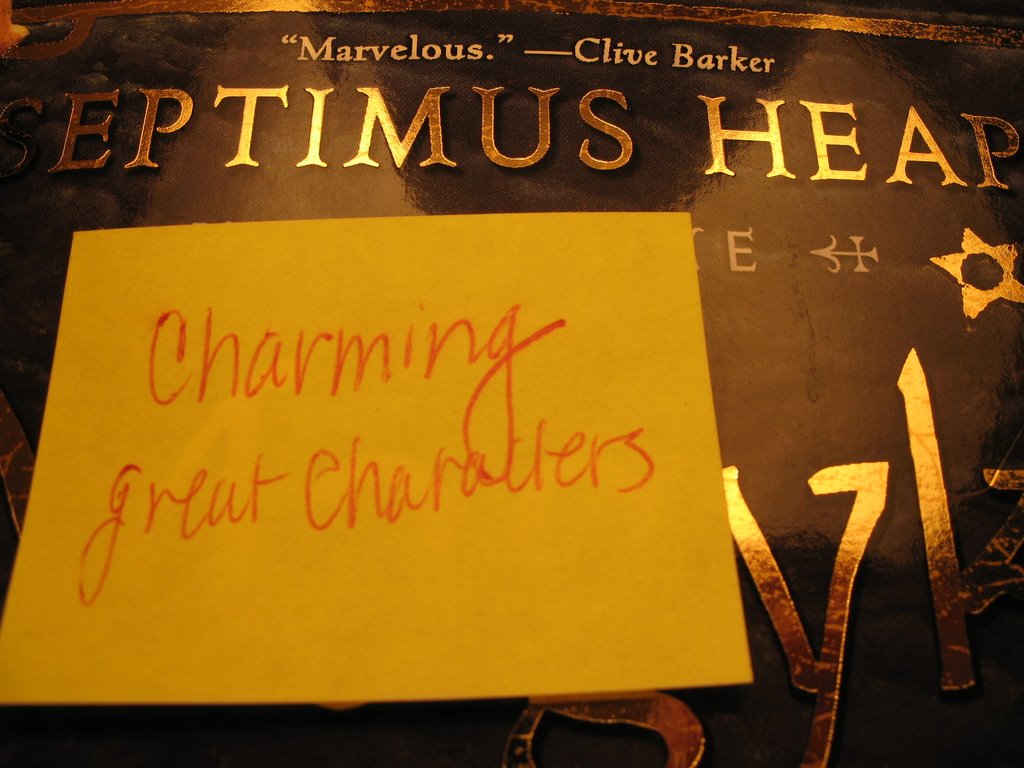
Septimus Heap: Magyk by Angie Sage
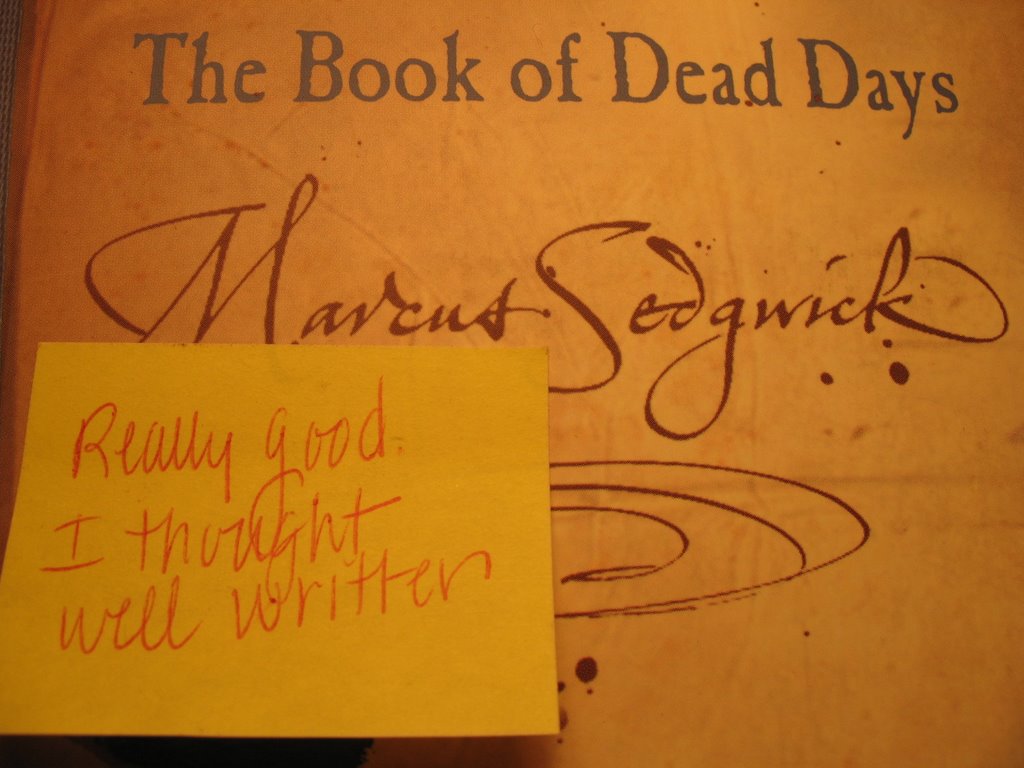
The Book of Dead Days by Marcus Sedgwick
Inkspell by Cornelia Funke -- This is a sequel to Inkheart, which I didn't really like. Mom thought this one was better, though, so I'll give it the old college try.

Pendragon: The Quillan Games by D.J. MacHale -- Ahhh...the long-awaited 7th book in the Pendragon series. This is soooo not your typical Arthurian legend/spin off book. There actually really aren't any connections (so far, anyways) to Arthurian legend. The main character is an American boy who is one of the "Travelers," a band of mysterious multi-universe travelers a bit a la Dr. Who. The first book started off slow, but now Mom and I are totally hooked. (P.S. Spell-check wanted to replace "Arthurian" with "earthworms." That's funny stuff.)

The other great thing about Mom Emergency Book-Drops is that she leaves great little notes on each one item included. I have a feeling if Mom-bo was ever asked to write a marketing quote for any of these books, they'd sound much like this. And she'd probably insist they be affixed to the cover via post-it note, as well.

I've vowed to work through a stack of library books (some of which have already been renewed a few times...er...) before consuming these, but my discipline may waver. Stay tuned for your breaking-news updates.

Friday, June 30, 2006

Books: Escapism Explored

So, work at the noodle factory (a.k.a. my textbook publishing gig) has been so gosh dang stressful lately (gosh DANG!), that I've found myself needing more than the usual amount of reality escapism. Reality escapism can come in many diverse and lovely forms, but after this past week, I am craving only one: young adult novels by Tamora Pierce.

My mom and I discovered Tamora Pierce several years ago in (Mom, correct me if I'm remembering wrong) a tiny little bookstore in Grand Marais, Minnesota. Mom was the official finder and original enthusiast; I was judgmental of the cartoony covers and silly titles. For example, "The Circle of Magic Quartet: Sandry's Book" shows a young noble-woman in several petticoats and a street boy wearing a billowing white peasant shirt sitting together on a rooftop overlooking a picturesque village of thatch-roofed cottages. Now, I will neither confirm nor deny the fact that I may or may not have once owned and coveted a billowy white peasant shirt of my own, BUT the fact remains that my first impression led me to believe that this was exactly the type of book that an ex-billowy white shirt wearer would write for the next generation of billowy white shirt wearers.

I scoffed; Mom ignored. Several months later, my mother kept telling me what great books these were. I still scoffed. Eventually a few Tamora Pierce books showed up in a care package, and I decided I needed to read them so that at least my future scoffing could reference specific page numbers.

And, well, the truth of the matter is that I was wrong. These are fantastic books. Tamora Pierce is an incredible story-teller and writer, this drawn primarily from the fact that her books are solidly character-driven. Very rarely do you as the reader feel that the writer is interfering with the plot or making a character do something contrary to the nature of the character she has built. Her characters are unique and each has a vibrant voice and complex personality. The plot enters into the story so naturally that you don't realize until you're halfway through the book that something more is going on besides hanging out with these really cool people.

Her main characters are primarily female (with one exception). This was a deliberate effort on Tamora Pierce's part to create a balance with all the books and stories she'd devoured when she was younger but that had mostly male main characters. (She talks about this and more on her website http://www.tamora-pierce.com/.) Her plots run the gamut from traditional fantasy "good mage vs. bad mage" to murder mystery. In the midst of character evolution and plot thickening, she incorporates such edgy topics as teen sex, homosexuality, drinking and drugs, race relations, and pretty much everything else that teenagers are insatiably curious about but about which there is little quality information that is geared toward that audience. (Tamora Pierce hands down does the best job of ANY author I've read, young adult or otherwise, of deftly incorporating main characters of many different races without making it into an 'issue.' Daja not black because Tamora Pierce decided she needed a little ethnic diversity; she's black because that's who she is.)

Tamora Pierce has a ton of books out (enough to see me through the busy season at the noodle factory), and she shows no sign of stopping. Keep in mind that these are young adult books, and while I find them infinitely escapism-worthy, they're still written with that audience in mind. Here's a brief-ish synopsis of the ones published thus far (I recommend reading them in the following order):

The Circle of Magic Quartet:
Book 1: Sandry's Book
Book 2: Tris's Book
Book 3: Daja's Book
Book 4: Briar's Book

This quartet deals with four unusually strong young mages. Their magic is manifested through ordinary things like gardening and knitting (see the appeal for me?!). They get to know themselves, each other, and their magic, and manage to get in to and out of lots of trouble at the same time.

The Circle Opens Quartet:
Book 1: Magic Steps
Book 2: Street Magic
Book 3: Cold Fire
Book 4: Shatter Glass

The story of the four mages from the Circle of Magic Quartet continues several years later. Now, they have separated and are traveling with their teachers. Each encounters a younger mage new to his or her power and assumes the responsibility of training that person. And along the way, they manage to get in to and out of a lot of trouble.

The Circle Reforged Quartet:
Book 1: The Will of the Empress
Other books due out in the next few years.

Again, we pick up the story of the four mages, again several years in the future. They have each had their share of tough growing-up experiences and have grown a lot since they were last together. Seeing each other again is like seeing strangers. In the first book of the series, the trouble they get into and out of manages to re-forge their old bonds.

The Song of the Lioness:
Book 1: Alanna
Book 2: In the Hands of the Goddess
Book 3: The Woman Who Rides Like a Man
Book 4: Lioness Rampant

This was Tamora Pierce's first series of books and are the most traditionally fantasy. Alanna, the main character in all four books, is a young girl who dreams of being a knight. Alas for her, only boys can become knights. She manages to disguise herself as a boy and hide her identity until she is fully knighted. Alas for her, she has made enemies along the way, who must of course be vanquished by the end of Book 4. All joking aside, these are a solidly written books and have several twists and turns that are unexpected and uniquely Tamora Pierce.

The Immortals Quest:
Book 1: Wild Magic
Book 2: Wolf-Speaker
Book 3: emperor Mage
Book 4: The Realms of the Gods

Taking place in the same world as the Lioness Quartet, this quartet follows the story of a young half-human/half-god girl with the ability to speak to (and become) animals. As Daine is growing into her powers, the land is becoming increasingly torn apart by mythological creatures called Immortals. Daine becomes involved in the quest to find the person behind the Immortals War and is key in bringing it to a close.

The Protector of the Small
Book 1: First Test
Book 2: Page
Book 3: Squire
Book 4: Lady Knight

The story of Kel takes place several years after the conclusion of both the Lioness Quartet and the Immortals Quest. Kel is the first girl to try for her knighthood after the ban on female knights was lifted post-Alanna. The quartet follows her years in training and is the only series to feature a non-magical main character. (P.S. Kel is my personal hero.)

Trickster's Choice and Trickster's Queen
This duo follows the story of Alanna's rebellious teenage daughter who accidentally (kinda) gets kidnapped by pirates and sold as a slave in an island kingdom across the sea. We soon find that a trickster god has chosen Alanna to help him overthrow a coup to win back the isles from his bully older brother god and sister god. (P.S. These are my all-time favorite two books by Tamora Pierce--but they don't make as much sense if you haven't read the others first.)