Showing posts with label Young Adult Fiction. Show all posts

Friday, September 05, 2008

Book Review: Twilight by Stephanie Meyer

Ok, before I sucked right into the second book, I thought I'd take a moment to a) resurface, b) eat dinner, and c) have a little chat with you about this book.

Have you read it? What did you think?

Here's the premise: Bella is a lovely young teenager who has reluctantly moved back to the small town in the Pacific Northwest where her father has been living. Despite a propensity to trip over her own feet, she manages to charm everyone at her new school and become Popular in a few days. She's got a great group of friends and several boys who follow her like puppies, but here's the hitch. Bella's got the hots for this guy Edward. And, as is revealed in dramatic play-by-play action, it turns out that he's a vampire. Smoldering looks, quickening heartbeats (on Bella's part, at least - hardy har har), and trouble ensues.

And this is my take: Twilight is a teenage romance novel at its very best, and
it had me hooked - right down to the last throaty whisper and drop of tantalizing blood. It's one of the most riveting and entertaining books I've read in a long time, by which I mean that I was only half joking when I said I was glued to the couch and a rumbling stomach was a major inconvenience.

A great novel, it was not. Masterfully written, it was not. There were a few too many 'smirks' and repetitious, round-about conversations between Bella and her vampire for my taste. But let's be clear about this: Twilight is a young adult novel and as such, it was exactly what it needed to be.

Meyer captured that particular and excruciating anxiety of being a teenager right down to the last self-conscious shoe lace.
The scenes and conversations felt very real and believable. In fact, many of her passages felt all-too close to my own memories of that time (particularly the scenes of Bella fumbling every attempt at grace in gym class). I could see a teenager reading this and finding solace for her own teenage-y discomfort.

Meyer also captured that equally particular and excruciating anxiety of being freshly in love, that time when a smile turns your bones to jelly and a frown feels like your world collapsing. Those early scenes between Bella and Edward - oh Lord, yes! I'd be lying if I said those scenes didn't make my own heart beat a little faster. There's a part of me that wants to give this book to every teenage boy (and a few grown men) and say, "Here! THIS is how you romance a lady! You're welcome!"

Her characters had me charmed from the get-go. Bella with her awkwardness and refreshing honesty. Mike, Tyler, and all her other admirers in their geeky boyishness. Bella's shy father and her relationship with him. And of course, Edward with all his inner turmoil, sureness, and chivalry.

The plot was decent, if predictable. I felt that the climactic turning point happened a little too abruptly, coming so swiftly on the heels of Bella and Edward finally getting their adorable/scintillating act together. There were a few moments that seemed glossed over in the rush to the finish - like how Bella becomes suddenly accepted by Edward's family.

Meyer can certainly paint a scene, though. Emerging from this book felt like coming out of an intense dream. I had to blink a few times and remind myself where I was. Even when the action was slow, I was still devouring every word without blinking.

I had a few rather major philosophical problems with the book, however. The first is the issue of love.

Bella is 17. Edward is 18 going on 100. They "fall in love" in about two weeks, and tell each other so very quickly. I feel that this scenario happens too frequently in young adult novels, and the conclusion is inevitably, yes, they really are in love. They will get married and be together forever. No trouble. No lasting heart ache. Love wins!

But I just feel that this isn't real. It's not how life works. And it feels contrived and convenient when it happens in novels. I fully admit that this may be my own world view and perhaps true love at 18 that lasts forever happens more than I think. But I think not. And even if so, what's wrong with saying, "Yes, I love you madly. Yes, I feel like I want to be with you forever." but then showing that sometimes love fizzles out? And that it's ok when that happens? What's wrong with showing that, huh?

What I'm getting at here, in my thinking-out-loud kind of way, is that I think novels that show teenagers falling in love - real, forever love - can be misleading for real-life teenagers. They think that the fireworks and electricity is how it will be forever, and when that mellows out or fizzles out, they think something is wrong. Or worse (and yes, this is most certainly my paradigm) they think that they've done something wrong and actually failed at love in some inexplicable way.

I just don't think showing characters jumping headlong into "forever" is a good example, I guess. I don't mean to rain on anyone's parade, but it would be nice to have a dose of reality in our fantasy now and then. Especially when the readers are young adults and are still trying to figure out how the world works.

The second issue is with how Edward treats Bella. Oh, he's chivalrous and gentlemanly, but there are so many scenes where he shuts her down, dismisses her wishes and desires, keeps her deliberately in the dark "for her own good", or makes it clear that he must protect her. It rings of old male-female/husband-wife patterns.

To her credit, Meyer has created a well-spoken, confident character in Bella, and Bella frequently stands up for herself and bullies Edward right back. Toward the end of the book, Bella brings up the idea of equality in their relationship, stating that "It just seems logical...a man and a woman have to be somewhat equal...as in, one of them can't always be swooping in and saving the other one. They have to save each other equally." It's not clear to me in the novel whether Edward really hears her or not, or if he just dismisses her as not really understanding what she's saying [which is that she wants to become a vampire, so they can be equal].

I'm not sure where this is headed. I'm curious, if a bit skeptical, to see how the relationship develops. Maybe the point is that Edward is from another era when the relationships between men and women weren't quite so equal, and he must now learn to be in an equal relationship. Or maybe Bella will succumb entirely to his topaz eyes and remarkable abilities to keep her safe. Who knows?

On that note, back to the couch I go! Luckily, I was able to procure some Fresca and Twizzlers in my brief resurfacing, so I should be good to go for the next few days.

Thursday, September 04, 2008

Do Vampires Eat Twizzlers?


Begin message. Must keep reading Twilight. Stop. Can't leave sofa. Stop. Food and water is too far away. Stop. Please send aid. Stop. Or an airlift of Fresca and Twizzlers. End Message.

Sunday, July 15, 2007

Harry Potter: Knit the Movie

I went to see the new Harry Potter move, "Order of the Phoenix," this Friday, and I have to admit that I don't remember much of it because I was so distracted by all the fabulous knit goods. I mean, who can follow the intricate machinations of Dumbledore's Grand Master Plan when there's patterns to be analyzed and yarn to be coveted?

Umbridge's wardrobe mistress must be Knitting Kinfolk. Scene after scene had me gasping with delight. Umbridge purty much stole the show, knit-wise, but don't miss Trelawny's stellar h
andbag:
There really are no words for this one. Except "yum":She had a whole train wreck of amazing sweaters, as well, but I didn't want to overwhelm you.

Stripes also made a grand showing:
It's hard to make out the detailed lacing on Luna's scrumptious lavender capelet, but it's well worth a closeup:And here's our crew, bedraggled yet triumphant, in all their knit glory:
Ron's sweater is particularly priceless. I don't know if Luna's pants are knit, but they should be. Or rather, they could be.

Anyhow, knitting distractions aside, the movie was really excellent. Similar Starbucks coffee, I've found that bringing up Harry Potter in conversation opens to the door to intense debate. People have some darn strong opinions about the inherent value of Harry Potter and its affect on the youth of today (and the rest of us)!
I happen to fall on the "thumbs up" side of the "Harry Potter: Yeah or nay?" fence. I always feel a need to justify why I like it to people, but really it just comes down to this: Folks, it's really not that big of a deal. I don't see the need to get all uppity about it--either for or against, really. (And if you feel that burning urge to take on a big franchise or two that's arguably ruining the youth of today, I suggest turning your attention Walt Disney or McDonald's.)

I'm very much looking forward to the last book coming out next week--both for the sheer delight and also so that I can finally put an end to the sense of incompleteness that's been like a hangnail in my psyche since I read the first book six years ago. Plus my gals and I are taking a trip to Cape Cod at the end of the month, and I think it will be perfect to read while lounging on the beach and showing off my Daisy Dukes.

Saturday, December 23, 2006

Book Review: The Brief History of the Dead

The Brief History of the Dead
by Kevin Brockmeier


Quickie Synopsis: In the city of the dead, life for the recently departed continues much as, well, life for the living. Restaurants are visited, jobs are attended to, new loves and old become reacquainted. The real plus side is that there's no need to worry about such trivial human concerns like eating well or exercising since you're already dead. And you suddenly have all the time you ever desired to stroll in the park or catch up on your reading. The city of the dead is a kind of holding area--you have definitely died, but you haven't quite yet left earth. There are still people down there who remember you and hold on to you. Until all the people you know have also died, you will stay in the city. And when the last person who remembers you dies, you disappear from the city, and none of the deceased residents knows where you disappear to.

On Earth, it is a time of war, of terrorism, of environmental collapse. Large groups of people appear and disappear suddenly in the city--gradually it is realized that no one left on Earth to remember the dead. As the population of the city slowly stabilizes again, a connection is discovered among the remaining residents: they all know or are somehow connected to a woman named Laura Byrd. And on Earth, Laura Byrd is struggling for survival. She is trapped in Antarctica, alone, running out of supplies, and unaware that she may very well be the last human on Earth.

-----

In The Brief History of the Dead, Kevin Brockmeier explores two classic philosophical questions: "What happens after we die?" and "What if you were the last person left on earth?" Each question follows its own thread, but the narratives weave through each other with a musical grace until the two are finally twined into a single inevitable piece. Neither story is quite strong enough to stand on its own, but when combined, they represent a moving and powerful whole.

Some of the most impressive writing in this novel comes in the character of Laura Byrd. Laura is an unlikely heroine for this novel. She is a mid-level employee at the Coca Cola Corporation and has been sent by her employer to Antarctica as part of a publicity campaign. She is billed as the team's wildlife expert, but she herself readily admits that her expertise in that area is rather lacking. Alone in the arctic desert and cut off from any other humans, she doesn't possess a great deal of survival knowledge, and endures mainly by virtue of fancy space-age equipment and her own tenacity to live. She is quirky and immensely lovable, reacting to situations in much the same way we might imagine ourselves reacting if we suddenly realized that we were trapped in an arctic science station while an epidemic was killing off the rest of humanity. Most significantly, we see Laura grow and develop as she reacts to new situations and new realizations about the reality of her situation. Brockmeier has created Laura's character to perfection.

And in stark contrast to Laura Byrd's high-action adventure, the segments of the novel that take place in the city of the dead have a dreamy, reflective quality. The newly dead are rediscovering what they loved about living and realizing that they have been given a second go-around at pursuing their dreams. Brockmeier meditates on what connects us to each other, crafting mini-stories that profile different residents of the city who are both close to and only loosely connected to Laura Byrd. While the movement and story of the city of the dead isn't as plot-driven or presented in the same sharp detail as Laura's story, the city is the necessary backdrop that gives Laura's story added substance and consequence.

Still, there were some aspects of this book that left me severely wanting. Take the title: The Brief History of the Dead. What did Brockmeier intend by calling this book a 'history'? Because it's not; it's really more of a "Brief Story of What's Happening to the Dead." Or "The City of the Dead: A Guidebook." One of the whole points of Brockmeier's version of the afterlife is that it's relatively timeless. There are days and nights, there are tomorrows and yesterdays, people come and leave the city, the weather fluctuates--but there prevailing understanding is that time is suspended. The inhabitants of the city are waiting. Nothing ever really happens in the city of the dead--no revolutions or political shenanigans, there are no famines or environmental disasters, no major inventions or leaps of humankind. In short, nothing happens to MAKE history. I toyed with the idea that the author is being ironic and is trying to emphasis the lack of history in the book by including it in the title. But really, I think he got lazy. I think he thought of a great title for a book a long time before writing it and clung to that title even as the book he was writing changed and grew to the point where the title was no longer the right fit. (P.S. Any grammar geeks out there want to have a go at discussing the significance and merit of calling this "THE history" as opposed to "A history"?!...Or perhaps I should say "AN history"....)

And let's talk about the city of the dead. This is an interesting idea: a city (just the one) like a cosmic waiting room where the dead go after their bodies have died but they are still half-alive in the memories of the people they knew on earth. It makes sense that these recently departed still have attachments to their earthly selves--their jobs, their hobbies, the idea that they need to eat, and so on. This idea inevitably led to some obvious holes in the conceptualization of the city--holes that I at first took to be intriguing intellectual puzzles, but with which I became increasingly frustrated as either they remained unresolved or they were resolved in a way that only let to more puzzles.

For instance, take the concept of money. At first I thought that there was no money in the city and everything operated on the Utopian ideal of plenty-for-all. But toward the middle of the book, there is a scene where a woman throws coins at another resident of the city because she thought he was begging. Aha! Money after all! But then: why? Why is there money? Where does it come from? What does it represent--is there a ghostly Fort Knox somewhere? How do people get it? Are there banks?

And where does the 'stuff' come from? Who makes the coins and where does the metal come from? Where do things like paper come from--paper to print the newspapers and book all the dead are reading? Where does the food come from? Are there fields being harvested somewhere in the land of the dead, somewhere off-screen? Or does food appear by magic in the larders of the restaurants and kitchens of the city? Maybe when the living back on earth think about food, food also appears in the land of the dead--spirit food! And do the dead actually need to eat anyway, or is it just force of habit?

At one point, one of the characters notices that the trash hasn't been picked up yet, which immediately made me wonder, "Who is choosing to spend their afterlife as a trash collector?" Maybe the dead don't get a choice. Maybe they automatically just do what they were doing when they died--whether they were a child or a retired person or a stockbroker. Maybe the whole technical operation of the city relies on the fact that people of all ages die and therefore the city of the dead has enough diversity to sustain all its functions.

The further I got into the book, the more these kinds of questions bugged me and distracted me from the story. I'll grant you that Brockmeier MAY have left these kinds of details intentionally ambiguous in an attempt to draw attention to the fact that we in the land of the living don't always have a good idea of where our goods come from and we often treat them as if they appeared by magic. That's possible. But I think not.

But just as with my suspicion with the title, my gut feeling is that Brockmeier got lazy. I don't think that Brockmeier knew the answers to these ambiguities and inconsistencies any more than the reader does. As any writer worth his or her salt knows, the writer needs to know every last detail of their story down to the color of Timmy's shoelaces and how many stoplights Mr. Jones passes on his way to work. If the author is completely conscious of the world and characters he or she is describing, the necessary details will naturally float to the top and the reader will be able to fill in the rest of the blanks on his or her own. These small details of shoelaces and stoplights may never make it into the final story; but it's the fact that the author has them firmly in mind as he or she is writing that deepens the story the same way a dash of secret spice will deepen the flavor of chili and make it a better stew without anyone being the wiser. Brockmeier clearly knew Laura Byrd's character inside and out, so why didn't he apply the same level of craft to the city of the dead?

Intended or otherwise, The History of the Dead only manages a superficial, if highly entertaining, look into some of humankind's deepest questions. It's this lack of depth that ultimately keeps an otherwise well-written and well-conceived book solidly in the camp of whimsical science fiction and prevents it from becoming anything more than an interesting philosophical jaunt.

-----

Final Recommendation: Worth the read

Good Read For When You're: Waiting at the airport, on vacation, or sick on the couch looking for good distraction.

Good Choice For: Science fiction fans, precocious teenagers, and philosophy majors thinking of switching to creative writing. Oh, and book groups. This is a bone fide book group read if I ever read one.

If You Liked This Book, You Might Also Like: Eva Moves the Furniture by Margot Livesay

Wednesday, December 13, 2006

Books: Charlie Bone and the Hidden King

Children of the Red King Book 5: Charlie Bone and the Hidden King
by Jenny Nimmo


Quickie Synopsis: On the eve of his 10th birthday, Charlie Bone finds that he can hear the voices of people in photographs. Fearing that he's going insane, Charlie instead discovers that he is one of the magically talented descendants of the Red King, an ancient monarch who had 10 children each endowed with special powers. Charlie is sent to boarding school at the mysterious Bloor's Academy where he meets other children with incredible talents and begins to realize that there is a rift in the descendants of the Red King, some of whom are working for good and others who are hungry for power. In this fifth book, Charlie Bone and his friends venture further into the mystery of the Red King, battle an ancient shadow, and get closer to the truth about Charlie's missing father.

Other books in the Children of the Red King Series:

Book 1: Midnight for Charlie Bone--in which Charlie first discovers his power, begins his adventures at Bloor's Academy, and searches for a missing girl.
Book 2: Charlie Bone and the Time Twister--in which an old relative of Charlie Bone and a nemesis of the Bloors is sent forward through time to Charlie's present day
.
Book 3: Charlie Bone and the Invisible Boy--in which Charlie Bone and his friends attempt to find and rescue an invisible boy named Ollie.

Book 4: Charlie Bone and the Castle of Mirrors--in which Charlie and his friends work to save Billy Raven from his sinister adopted family

-----

Ok, you're all thinking it, so let's get it out in the open: This "Children of the Red King" series bears so many similarities to the Harry Potter series by JK Rowling that it's almost laughable. Slightly clueless boy who still somehow becomes the magnetic leader of his group of friends? Check. Magical academy set in a castle-like manor with twisty hallways, lofty ceilings, and portraits of stuff old people? Check. An inevitable battle between good and evil building over the course of several books? Check. And unfortunately, since these books came out after the beginning of the Harry Potter craze, I don't even think it's possible to say Jenny Nimmo wasn't influenced by the Potter books.

But here are the positives and why these books are worth reading: Nimmo's series is geared toward a younger audience who may not be ready for the darker, more complicated Harry Potter books. They would be perfect for an eager second grader all the way on up to a fifth grader. Despite some of the iconic resemblances to the Potter series, Nimmo stands on her own with unique characters, engaging dialogue, and unexpected plot situations. Her books are solidly well-written and vibrant with a spark and creativity that is all Nimmo's own.


Having said this, Book 5: Charlie Bone and the Hidden King was a bit of a disappointment. A lot of the same attributes that really distinguished Nimmo's books in the past ended up falling flat in this latest installment. The dialogue was often stilted and peppered with the kind of bland, characterless phrases that you might find in the first meeting of a Short Fiction 101 class. The characters, who readers have grown to love over the course of the previous four books, appear fickle and one-dimensional. Perhaps in response to criticisms that her plot development has been too predictable in her past books, the storyline in Book 5 takes so many sharp turns and felt so cobbled together that it left me feeling bewildered, confused, and ultimately unsatisfied. Even the long-anticipated unveiling of Charlie's true father wasn't enough to pull this book out of its doldrums.


More than anything else, it felt like Nimmo lost confidence in her vision for the series. Flipping through the front of the book, I see that Nimmo has dedicated the book to the memory of her editor, Miriam Hodgson. I wonder if the death of her editor can partly explain the loss of momentum in this book--or if her editor was the real powerhouse behind the spark and creativity in the series? It's unclear whether or not this is the final book in the series. In many ways I hope it isn't the end of the series. This would be a disappointing and anticlimactic end to what is otherwise a fantastic and imaginative middle-reader series. I have faith that Nimmo can reconnect with her original enthusiasm and desire for this project, and bring series to a more powerful conclusion in another book.

Wednesday, August 02, 2006

Books: Gifts by Ursula LeGuin

Gifts
by Ursula LeGuin

Ok, I tried to stick to the 'Library Books Only' diet, but couldn't resist that stack of colorful, glossy books with such wonderfully tempting titles. Ah well, what can I say? I'm weak-willed like that.

Quick Synopsis: The people of the Uplands live a stark and rough existence that always borders on starvation and inter-clan warfare. Their only defense against neighboring clans and their only bargaining tool in forming alliances are the mysterious and fearsome Gifts. The Gift can be the ability to cut like a knife with only a glance, to destroy a hillside of vegetation with a single gesture, to call animals to the hunt with a thought. These hereditary powers are guarded jealously and are carefully passed down from father to son and mother to daughter. This is the way it has always been, but two children who are coming into their power begin to question whether these Gifts could be used for a greater good, rather than as mere tools in the ongoing struggle to survive.

Ursula LeGuin's strong point has always been her ability to use masterful storytelling as a vehicle for social commentary, forcing her readers to examine their own beliefs and worldviews. Again and again, her books and short stories raise probing questions about why things are the way they are. Though it might not be quite on par with Left Hand of Darkness or The Ones Who Walk Away from Omelas (short story), Gifts follows in this same tradition. Its message is familiar, though an important one for teen-people: we don't often get to choose the tools we are given, but we do get to choose how we use them.

The greatest strength in Gifts is its characters. Orrec, our main character and hero, is every bit the teenage boy teetering between childhood and adult life. He is frightened by his powers, rebellious toward his father and inheritance, and full of fiery passion--in short, a teenage girl's dreamboat. His best friend, Gry, has an equally rich character--deeply soulful and spirited. Their conversations and the dialogue between other characters in the book are natural and well-paced. LeGuin's setting in a remote, bitter landscape and descriptions of the Uplander people draw the reader even further into the world of Upland

While I firmly believe that the hallmark of a great work of writing is strong, desire-driven characters, the brilliant characters still need a plot in which to do their thing. And this is where LeGuin falls short. The book opens promisingly enough with a mid-winter, fire-side discussion between Orrec, Gry, and a mysterious stranger from the even more mysterious Lowlands. I was gleefully anticipating a dangerous hero-quest of some sort to ensue. Unfortunately, the story very quickly slides back in time to several months earlier when Orrec's gift is first awakening. We don't return to the fireside chat until the very end of the book, at which point we find out that the mysterious stranger in fact has no real bearing on the book at all and is more or less a random passerby. In my mind, this violates one of the cardinal rules of writing: If you put a dagger on the mantle in Scene 1, there better be murder by Act 2. LeGuin set the stage as if the stranger was going to have meaning in the story, but ultimately he was an unnecessary character who did not add to the book. In writing, everything should have meaning, or in all honesty, it should be cut from the manuscript. What's cardinal rule #2, 'o my fellow writers? That's right: kill your darlings.

There are some jumps and starts of minor plots throughout the rest of the book--Orrec's struggle with his father, a possible alliance with a dangerous neighbor, murder via covert use of the Gift. But this coming of age story lacks a real pivotal plot around which to make the transformation believable, and ultimately, it feels forced. The book still 'works' and is carried along by the fact that LeGuin is a brilliant storyteller with a fresh perspective on a traditional theme in young adult literature. Her ability to completely enthrall her audience with language that transports you right into the story and characters that feel like friends outweighs the slipshod crafting of the plot.

Monday, July 24, 2006

Books: Emergency Book-Aid-Drop from the land of Minnesota

Oh, delight of all possible earthly delights, today the 10 am mail delivery at my office bequeathed to me a package from my very own mother. Like a skein of Noro yarn in the $1 bin at a yard sale, I spotted it immediately amongst its FedEx brethren of packages returned as undeliverable, new projects, and far more complimentary copies of "Introduction to Biology, Eleventy-hundreth Edition" than I could ever hope to use. A (perhaps) shrill "Yippie!" was heard from my direction, causing my cube-neighbors to peer at me over their cups of coffee in a puzzled, groggy sort of way.

My mother and I share a long and (yes) fanatical devotion to young adult fantasy novels. Occasionally other sorts of young adult
novels will find their way into the mix, but we're pretty exclusive. We'll read just about anything once, tend to have very similar tastes about what we've read, and have been known to discuss them far into the reaches of the phone bill (now we have the same phone plan and don't have to worry about such pithy restraints). Since Mom-bo lives in rural Minnesota, she orders most of her books online and from catalogues, and she very generously passes them on to me when she's done.

Today was a nice mix of books I was expecting (because we've been talking about them) and surprise books. They came at the perfect time because my Tamora Pierce marathon needs a bit of a mile-15 water break. Here's the run-down:

Troll Fell by Katherine Langrish
Gifts by Ursula Le Guin -- Mom and I *think* this is the first YA book Ursula Le Guin has put out for a while. I've missed a few, but I think the last time I read anything new by her, I was in middle school. Muy exciting!
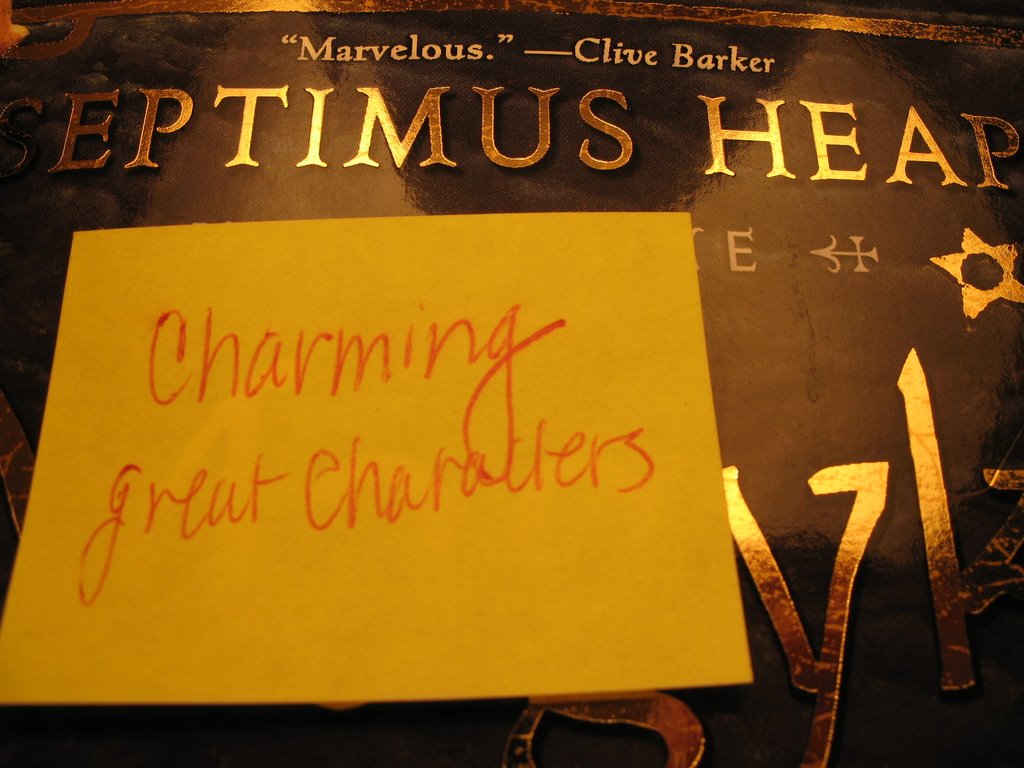
Septimus Heap: Magyk by Angie Sage
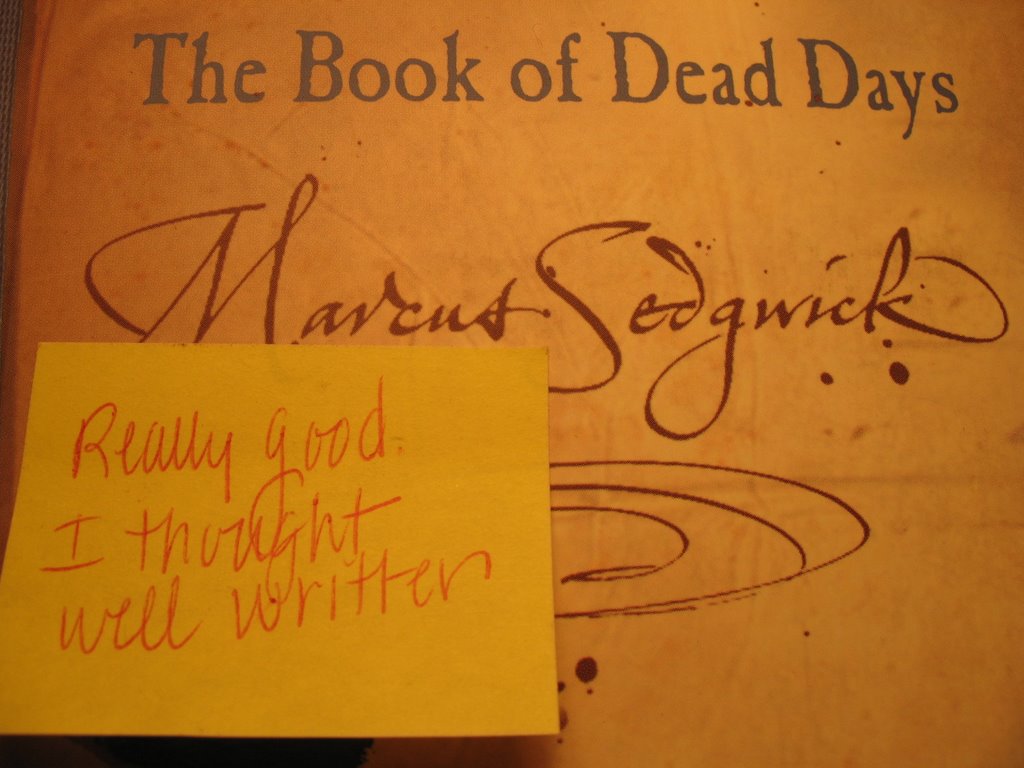
The Book of Dead Days by Marcus Sedgwick
Inkspell by Cornelia Funke -- This is a sequel to Inkheart, which I didn't really like. Mom thought this one was better, though, so I'll give it the old college try.

Pendragon: The Quillan Games by D.J. MacHale -- Ahhh...the long-awaited 7th book in the Pendragon series. This is soooo not your typical Arthurian legend/spin off book. There actually really aren't any connections (so far, anyways) to Arthurian legend. The main character is an American boy who is one of the "Travelers," a band of mysterious multi-universe travelers a bit a la Dr. Who. The first book started off slow, but now Mom and I are totally hooked. (P.S. Spell-check wanted to replace "Arthurian" with "earthworms." That's funny stuff.)

The other great thing about Mom Emergency Book-Drops is that she leaves great little notes on each one item included. I have a feeling if Mom-bo was ever asked to write a marketing quote for any of these books, they'd sound much like this. And she'd probably insist they be affixed to the cover via post-it note, as well.

I've vowed to work through a stack of library books (some of which have already been renewed a few times...er...) before consuming these, but my discipline may waver. Stay tuned for your breaking-news updates.

Friday, June 30, 2006

Books: Escapism Explored

So, work at the noodle factory (a.k.a. my textbook publishing gig) has been so gosh dang stressful lately (gosh DANG!), that I've found myself needing more than the usual amount of reality escapism. Reality escapism can come in many diverse and lovely forms, but after this past week, I am craving only one: young adult novels by Tamora Pierce.

My mom and I discovered Tamora Pierce several years ago in (Mom, correct me if I'm remembering wrong) a tiny little bookstore in Grand Marais, Minnesota. Mom was the official finder and original enthusiast; I was judgmental of the cartoony covers and silly titles. For example, "The Circle of Magic Quartet: Sandry's Book" shows a young noble-woman in several petticoats and a street boy wearing a billowing white peasant shirt sitting together on a rooftop overlooking a picturesque village of thatch-roofed cottages. Now, I will neither confirm nor deny the fact that I may or may not have once owned and coveted a billowy white peasant shirt of my own, BUT the fact remains that my first impression led me to believe that this was exactly the type of book that an ex-billowy white shirt wearer would write for the next generation of billowy white shirt wearers.

I scoffed; Mom ignored. Several months later, my mother kept telling me what great books these were. I still scoffed. Eventually a few Tamora Pierce books showed up in a care package, and I decided I needed to read them so that at least my future scoffing could reference specific page numbers.

And, well, the truth of the matter is that I was wrong. These are fantastic books. Tamora Pierce is an incredible story-teller and writer, this drawn primarily from the fact that her books are solidly character-driven. Very rarely do you as the reader feel that the writer is interfering with the plot or making a character do something contrary to the nature of the character she has built. Her characters are unique and each has a vibrant voice and complex personality. The plot enters into the story so naturally that you don't realize until you're halfway through the book that something more is going on besides hanging out with these really cool people.

Her main characters are primarily female (with one exception). This was a deliberate effort on Tamora Pierce's part to create a balance with all the books and stories she'd devoured when she was younger but that had mostly male main characters. (She talks about this and more on her website http://www.tamora-pierce.com/.) Her plots run the gamut from traditional fantasy "good mage vs. bad mage" to murder mystery. In the midst of character evolution and plot thickening, she incorporates such edgy topics as teen sex, homosexuality, drinking and drugs, race relations, and pretty much everything else that teenagers are insatiably curious about but about which there is little quality information that is geared toward that audience. (Tamora Pierce hands down does the best job of ANY author I've read, young adult or otherwise, of deftly incorporating main characters of many different races without making it into an 'issue.' Daja not black because Tamora Pierce decided she needed a little ethnic diversity; she's black because that's who she is.)

Tamora Pierce has a ton of books out (enough to see me through the busy season at the noodle factory), and she shows no sign of stopping. Keep in mind that these are young adult books, and while I find them infinitely escapism-worthy, they're still written with that audience in mind. Here's a brief-ish synopsis of the ones published thus far (I recommend reading them in the following order):

The Circle of Magic Quartet:
Book 1: Sandry's Book
Book 2: Tris's Book
Book 3: Daja's Book
Book 4: Briar's Book

This quartet deals with four unusually strong young mages. Their magic is manifested through ordinary things like gardening and knitting (see the appeal for me?!). They get to know themselves, each other, and their magic, and manage to get in to and out of lots of trouble at the same time.

The Circle Opens Quartet:
Book 1: Magic Steps
Book 2: Street Magic
Book 3: Cold Fire
Book 4: Shatter Glass

The story of the four mages from the Circle of Magic Quartet continues several years later. Now, they have separated and are traveling with their teachers. Each encounters a younger mage new to his or her power and assumes the responsibility of training that person. And along the way, they manage to get in to and out of a lot of trouble.

The Circle Reforged Quartet:
Book 1: The Will of the Empress
Other books due out in the next few years.

Again, we pick up the story of the four mages, again several years in the future. They have each had their share of tough growing-up experiences and have grown a lot since they were last together. Seeing each other again is like seeing strangers. In the first book of the series, the trouble they get into and out of manages to re-forge their old bonds.

The Song of the Lioness:
Book 1: Alanna
Book 2: In the Hands of the Goddess
Book 3: The Woman Who Rides Like a Man
Book 4: Lioness Rampant

This was Tamora Pierce's first series of books and are the most traditionally fantasy. Alanna, the main character in all four books, is a young girl who dreams of being a knight. Alas for her, only boys can become knights. She manages to disguise herself as a boy and hide her identity until she is fully knighted. Alas for her, she has made enemies along the way, who must of course be vanquished by the end of Book 4. All joking aside, these are a solidly written books and have several twists and turns that are unexpected and uniquely Tamora Pierce.

The Immortals Quest:
Book 1: Wild Magic
Book 2: Wolf-Speaker
Book 3: emperor Mage
Book 4: The Realms of the Gods

Taking place in the same world as the Lioness Quartet, this quartet follows the story of a young half-human/half-god girl with the ability to speak to (and become) animals. As Daine is growing into her powers, the land is becoming increasingly torn apart by mythological creatures called Immortals. Daine becomes involved in the quest to find the person behind the Immortals War and is key in bringing it to a close.

The Protector of the Small
Book 1: First Test
Book 2: Page
Book 3: Squire
Book 4: Lady Knight

The story of Kel takes place several years after the conclusion of both the Lioness Quartet and the Immortals Quest. Kel is the first girl to try for her knighthood after the ban on female knights was lifted post-Alanna. The quartet follows her years in training and is the only series to feature a non-magical main character. (P.S. Kel is my personal hero.)

Trickster's Choice and Trickster's Queen
This duo follows the story of Alanna's rebellious teenage daughter who accidentally (kinda) gets kidnapped by pirates and sold as a slave in an island kingdom across the sea. We soon find that a trickster god has chosen Alanna to help him overthrow a coup to win back the isles from his bully older brother god and sister god. (P.S. These are my all-time favorite two books by Tamora Pierce--but they don't make as much sense if you haven't read the others first.)